Why AI Literature Reviews Cite Papers That Do Not Exist
Ask a general-purpose chatbot for a literature review and it will happily produce twenty references. Some of them are real. Some have the right authors but the wrong year, or the right journal but a volume number nobody can find. The model predicts what a citation should look like; retrieval from an actual database never happens.
The fix is structural rather than moral: separate the work into three jobs and give each job to a tool built for it. Perplexity is good at scanning the open web with linked sources. Consensus is built to check claims against research papers, preprints included. NotebookLM answers only from the sources placed inside each notebook, so its answers stay inside your corpus; it can still miscite a passage or misread a table, which is what the inline citations are for.
This article maps each tool to a stage, compares current pricing (US list prices, checked against official pricing and help pages on 2026-11-11), and ends with budget recommendations for three researcher profiles.
Pricing and Free Tiers, Verified November 2026
All three tools are usable at $0. The differences show up when your workload grows past a course paper.
| Dimension | Perplexity | Consensus | NotebookLM |
|---|---|---|---|
| Role in the pipeline | Stage 1: scan the open web | Stage 2: check claims against research papers | Stage 3: synthesize your own corpus |
| Free tier | Unlimited basic searches; 3 Pro Searches/day; 1 Research query/month | Unlimited basic searches; about 10 Pro analyses and 3 deep reviews/month | 100 notebooks; 50 sources per notebook; compute allowance refreshes every 5 hours up to a weekly cap |
| Entry paid tier (NotebookLM tier follows its Google AI plan) | Pro $20/month ($17/month billed annually) | Pro $12/month | Google AI Plus $4.99/month |
| Key change after paying | Pro Search and Research (Deep Research) quotas allocated weekly, exact counts unpublished; model picker | Unlimited Pro messages; about 15 deep reviews/month | NotebookLM Plus: 200 notebooks and 100 sources each; 2x usage allowance |
| Next tier up | Max $200/month | Team plans (quoted) | NotebookLM Pro (Google AI Pro $19.99/month): 500 notebooks, 300 sources, 4x allowance |
The numbers above were checked against the vendors' official pages on 2026-11-11: perplexity.ai's plan comparison page, Consensus pricing and support.google.com's Gemini Notebook plan page. Two notes on the fine print. Perplexity's help center states the free plan's exact numbers (3 Pro Searches per day, 1 Research query per month) but publishes only "weekly limits" for paid plans, so all Perplexity publishes is "weekly limits" with no counts; "Research" is the Deep Research feature. NotebookLM dropped fixed daily counts on 2026-09-02 (per the Google support page above): consumer usage now runs on a compute-based allowance that refreshes every 5 hours up to a weekly cap, which is why older guides quoting "50 chats per day" are out of date.
Consensus deserves a closer look because it is the highest-value upgrade for the verification stage and the one of the three whose corpus maps closest to evidence checking: research papers first, with preprints that have not gone through peer review included. Ask it "Does caffeine improve exercise performance?" and it returns a snapshot of relevant studies, each labeled as supporting, contradicting, or inconclusive, with the actual paper one click away. The free tier's roughly 10 Pro analyses and 3 deep reviews per month run out fast once you juggle several parallel or multi-year projects; Pro lifts Pro messages to unlimited, with about 15 deep reviews monthly.
Sign-up: perplexity.ai
Sign-up: consensus.app
Try it: notebooklm.google.com
Running the Three-Stage Workflow
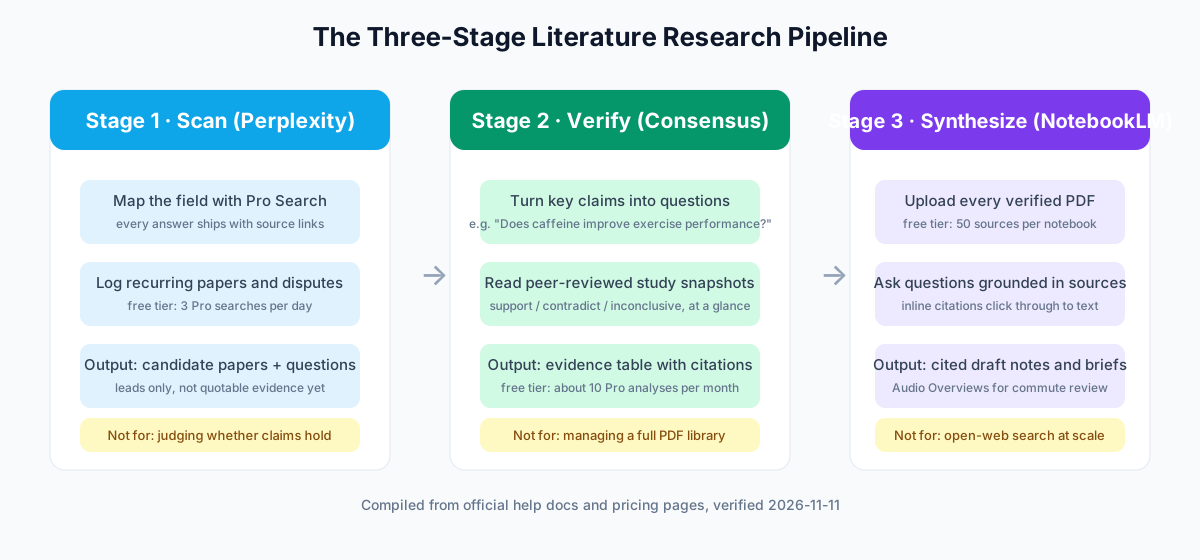
Stage 1 belongs to Perplexity. Start with a broad Pro Search on your topic, then narrow to the disputes: which findings keep coming up, and where do authors disagree? Every answer arrives with linked sources, so you can pull candidate papers into a list without leaving the page. The free tier's 3 Pro Searches per day is a real constraint, which is why this stage should produce a written list of questions before you spend anything.
Stage 2 belongs to Consensus. Convert each candidate claim into a question a database can answer and run it there. What you get back is a stack of study snapshots with agreement labels and links to the papers themselves. This is the step that catches the fabricated or overgeneralized citation before it reaches your draft.
Stage 3 belongs to NotebookLM. Upload the verified PDFs into one notebook (50 sources on the free tier, 100 on NotebookLM Plus), then interrogate your own corpus. Answers come with inline citations that click through to the source; the landing spot is not always the sentence you meant, so check what you land on. Audio Overviews are a decent way to re-hear your reading list on a commute, though they consume the usage allowance noticeably faster than plain chat.
 🔍 View full resolution
The ordering matters. Running Consensus before Perplexity wastes the free tier’s roughly 10 monthly Pro analyses on claims nobody made. Uploading unverified PDFs into NotebookLM just gives a confident summarizer more material to summarize confidently.
What Each Tool Will Not Do
Perplexity will not tell you whether a study is well designed. It surfaces what the web says, and preprint-heavy topics can make a single noisy result look like a consensus. Its Research reports are long and cited, but citation and peer review are different things.
Consensus will not manage your library or draft your prose. It answers focused questions about what the literature shows. Ask it to "summarize my thesis topic" and you are using the wrong tool; ask it a well-formed hypothesis question and it is exactly the right one.
NotebookLM will not search the web for you (web sources are supported, but the tool is designed around your own uploads), and it cannot rescue you from uploading weak sources in the first place. Its answers are constrained to the sources you put in; it can still miscite inside them. Google's own rate-limit page is explicit that free accounts get 100 notebooks and 50 sources each; a 60-paper literature review does not fit a single free notebook, which is the concrete reason NotebookLM Plus exists.
Budgets and Final Verdict
 🔍 View full resolution
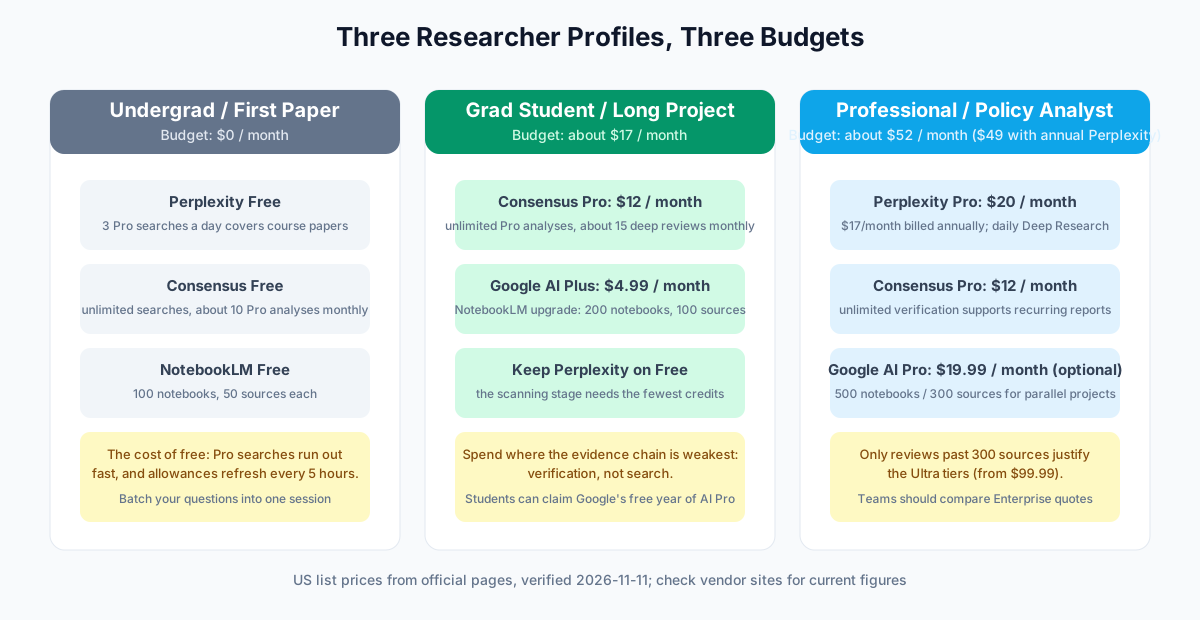
Choose the all-free stack if: you are writing course papers with a deadline measured in weeks. Three Perplexity Pro Searches a day, batched into one morning session, plus Consensus's free analyses and a 50-source NotebookLM cover it. The discipline of batching questions is the price you pay instead of cash.
Choose the ~$17/month stack if: you are a grad student on a multi-year project. Consensus Pro at $12 lifts Pro messages to unlimited (deep reviews remain about 15 a month), and Google AI Plus at $4.99 lifts NotebookLM to 200 notebooks and 100 sources. Keep Perplexity free; the scanning stage still uses Pro Search, just within the daily cap of 3. Eligible students should first check the Gemini Notebook plan page on support.google.com for the student offer (a free year of AI Pro, redeemable by 2026-12-31); the offer covers the NotebookLM Pro tier and sits outside the $4.99 plan, so once redeemed this stack drops to about $12/month.
Choose the ~$52/month stack if: research is your job. The three monthly plans add up to about $52; with Perplexity on annual billing the stack lands near $49. Perplexity Pro ($20/month, $17/month billed annually) adds Deep Research on weekly-allocated quotas for reports (exact counts unpublished), Consensus Pro ($12) keeps Pro analyses unlimited (deep reviews stay at about 15 a month), and Google AI Pro ($19.99) handles parallel projects up to 300 sources per notebook. Only go past this when a single notebook needs more than 300 sources; the Ultra tiers start at $99.99 (pricing on the plan page) and most reviewers will never need them.
One pricing trap worth naming: Perplexity’s paid plans reward annual commitments, and student pricing exists on perplexity.ai (Education Pro at $10/month, SheerID-verified) and across Google's AI plans. Verify eligibility before paying the full list price.