Why the per-second rate suddenly matters
Sora 2 no longer accepts new API calls: OpenAI removed the sora-2 models from its Videos API on September 24, 2026, a date documented in OpenAI's API lifecycle notice and tracked by third-party pricing monitors, and the current OpenAI pricing page no longer lists Sora at all. Budgets that were built around Sora now have to be rebuilt around Google, Runway, Luma and Pika.
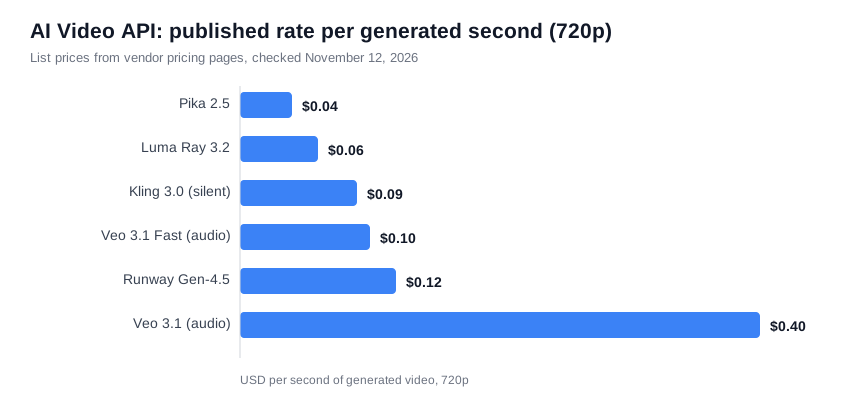
Almost every rate in this article is a published list price taken from vendor pricing pages and API docs, checked on November 12, 2026; the one exception is the Pika 2.5 figure, quoted from the Teamday compilation because Pika's own catalog page is behind a login. The November 2026 model roundup from Teamday cross-references the same figures; links in the table point to the pages that publish each headline rate: Google's page covers the Veo rows, the Runway catalog covers Gen-4.5 and the Kling 3.0 credit rates, Luma's API page covers Ray 3.2, and the Pika 2.5 figure is quoted from the Teamday compilation.
The per-second rate table at 720p
Runway sells most competing models through its own credit balance at $0.01 per credit, which makes its API pricing page the single most convenient place to compare rates. Google sells Veo through Vertex AI, Luma and Pika bill through their own APIs.
| Model | Sold via | 720p list rate | Clip length | Synced audio |
|---|---|---|---|---|
| Veo 3.1 | Google Vertex AI | $0.40 with audio, $0.20 silent (4K: $0.60 / $0.40) | 4-8 s, extendable | Optional |
| Veo 3.1 Fast | Google Vertex AI | $0.10 with audio ($0.12 at 1080p) | 4-8 s | Yes |
| Pika 2.5 | Pika API catalog | $0.04 ($0.06 at 1080p) | Not stated | Not documented |
| Luma Ray 3.2 | Luma API | $0.06 ($0.24 at 1080p) | 10 s | Not documented |
| Kling 3.0 Standard | Runway API credits | $0.09 silent, $0.13 with audio | 15 s | Optional |
| Runway Gen-4.5 | Runway API credits | $0.12 | 2-10 s | No on API |
 🔍 View full resolution
What a 30-second ad really bills
A finished 30-second spot is rarely one generation. Clips run 5 to 10 seconds, most teams keep one take in three, and a realistic composite uses four to six clips. That lands near 90 billable seconds, which turns the table into concrete numbers: $3.60 on Pika 2.5, $5.40 on Luma Ray 3.2 at 720p, about $8.10 on Kling 3.0 without audio, $10.80 on Runway Gen-4.5 and $36 on Veo 3.1 with audio.
Three levers move those figures. Resolution is the big one: Luma Ray 3.2 jumps from $0.06 to $0.24 per second at 1080p, a 4x step. Billing for failed generations is the quiet one: vendors differ on whether blocked or failed outputs are charged, so check that policy before a batch run. Surcharges form the third: HDR grading doubles the Luma Ray 3.2 rate (HDR and EXR file delivery are both listed on Luma's API page), and ProRes or PNG sequence delivery costs an extra 5 credits per second on Runway.
Discounts and deadlines that change the math this month
Kling 4.0 is 20% off through November 30, 2026 UTC on Runway: the 720p rate drops from 15.7 to 12.56 credits per second without an input video. The docs' own worked example bills a 5-second clip at 64 credits, about $0.64, because the list-price charge is rounded up first, the 20% discount is applied, and the result is rounded up again. The same catalog carries Google's low-cost line too: Gemini Omni Flash text-to-video runs 10 credits per second at 720p (about $0.10), and the newer gemini_omni_flash_1.2 bills 7 credits per second at 720p.
None of these numbers are contract prices. The past six weeks have seen Sora removed and Kling 4.0 discounted, so re-check the vendor page before locking a monthly budget.
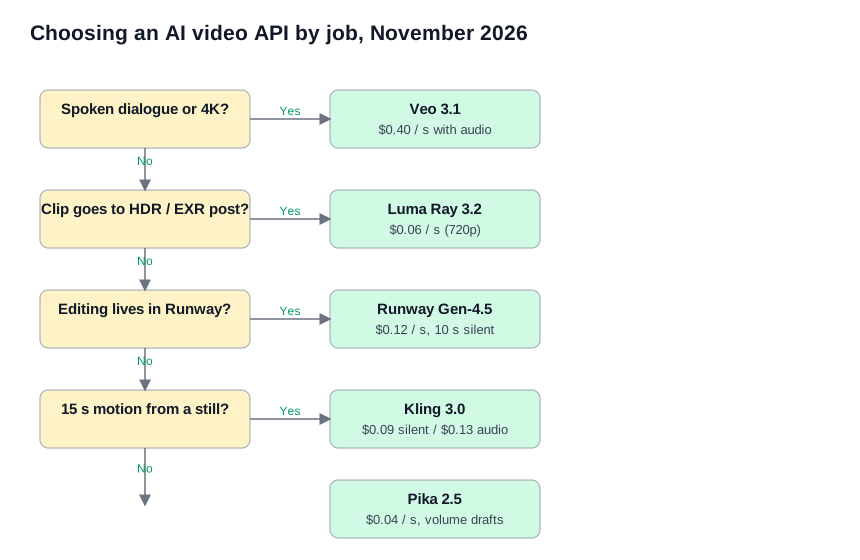
Which model for which job
 🔍 View full resolution
Choose Pika 2.5 if: volume beats polish, for example draft loops and A/B tests for social feeds at $0.04 per second.
Choose Kling 3.0 if: a still image needs 15 seconds of cinematic motion, with audio available at $0.13 per second when the scene calls for it.
Choose Runway Gen-4.5 if: editing already happens inside Runway and silent clips of up to 10 seconds at $0.12 per second fit the pipeline.
Choose Veo 3.1 if: the scene carries spoken dialogue or needs 4K; audio bills $0.40 per second at 720p, and at 4K it is $0.60 with audio or $0.40 silent; it is the table's pick for synchronized dialogue audio.
Choose Luma Ray 3.2 if: the clip feeds a post-production pipeline that needs HDR grading or EXR file delivery.