Pro is the gate, and the gate is still half shut
OpenAI's announcement is dated November 13, 2026. Wallet is the checkout its dot agent uses. The same post says the first wave is ChatGPT Pro subscribers in the United States, age 18 and older, with an eligible US-issued card. The Help Center page fetched the next morning is tighter: the person has to live in the United States, the card needs a US billing address, and the cards named there are US-issued American Express, Chase, Mastercard, and Visa. American Express, Mastercard, and Visa are the networks. Chase is the issuing bank. On a Chase card the account must be the primary cardholder, not an authorized user. The bank may still ask for a separate check while the card is being added.
Access is not a switch that flips for every Pro login on day one. The help page says the feature is rolling out gradually, and an eligible Pro user in the United States might not see it yet. When it does show up, it lives in a dot conversation. It is absent from Chat, from Work, and from a standalone Codex thread. A dot has to exist before a card can be added. The announcement's own scale line is 1.2 billion weekly ChatGPT users. That figure is OpenAI's, and it describes the whole product, not the number of people who can pay with Wallet this week.
 🔍 View full resolution
Try it: openai.com/index/introducing-chatgpt-wallet
Try it: help.openai.com/en/articles/20001654-making-purchases-with-chatgpt-wallet
What the payer actually confirms
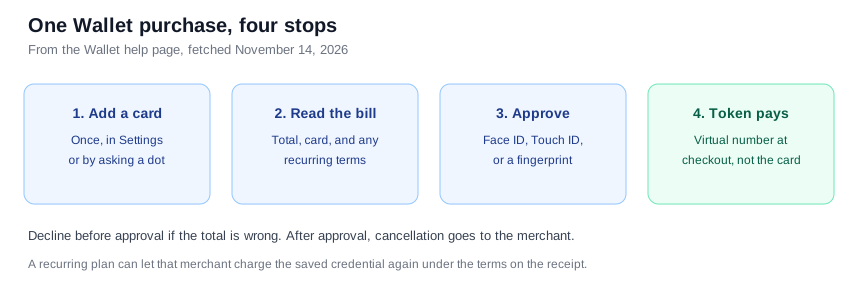
A card is added once, either by asking the dot or from the Wallet section of Settings. Both paths open a card form. The help page is explicit that this card is separate from the card that pays for the ChatGPT subscription, and separate from any gift-card or prepaid balance.
Before money moves, the user reviews the items, the total, the selected card, and any recurring-payment terms, then approves with a security check. The announcement names Face ID or a fingerprint scan. The help page names Face ID or Touch ID on a supported device. Approval is also the record of what the agent was allowed to buy. After that, the payment network supplies a token in place of the real card: a number, a security code, and an expiration date. The help page calls the number a virtual card and says the digits at checkout can differ from the digits on the plastic. The charge hits the selected card. The announcement says the real card details are not shared with the store or with the agent, and that existing card rewards and protections for eligible disputes stay in place.
 🔍 View full resolution
Two exits matter more than the token diagram. Before approval, the request can be declined. After approval, cancelling a completed order is a request to the merchant. The chat has no cancel control for that order. If the receipt was a recurring or continuous plan, the merchant may store the credential and charge it again under those terms. Unrecognized, declined, or pending charges go to the card issuer. A Wallet error, a suspected account takeover, or a purchase that does not match what was approved goes to OpenAI support.
The bill is the Pro plan, not a new Wallet SKU
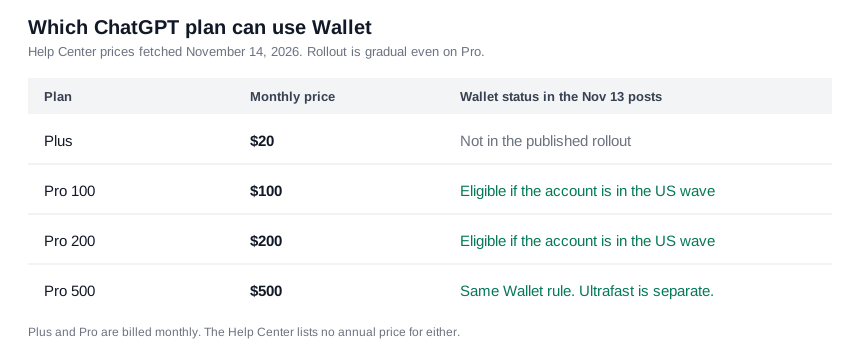
The November 13 announcement does not publish a Wallet subscription, a per-purchase fee, or a foreign-transaction cut taken by OpenAI. The official Help Center documentation does not list an extra fee either. The prices below are the ChatGPT plans that decide whether Wallet is even on the menu. Plus is $20 a month on the Plus help page, billed monthly, with no annual option. The Pro tiers page lists three monthly plans and no annual billing: Pro 100 at $100, Pro 200 at $200, and Pro 500 at $500. Ultrafast models are included on Pro 500 only. Ultrafast on Pro 500 is a speed tier. Wallet eligibility reads the same on all three Pro prices. Plan rates are based on the official OpenAI Help Center.
| Plan | Monthly price | Annual billing | Wallet in the Nov 13 rollout |
|---|---|---|---|
| Plus | $20 | Not offered | Not in the published eligibility list |
| Pro 100 | $100 | Not offered | Eligible US accounts, gradual |
| Pro 200 | $200 | Not offered | Eligible US accounts, gradual |
| Pro 500 | $500 | Not offered | Same Wallet rule. Ultrafast is included here only |
Sign-up: chatgpt.com
Try it: help.openai.com/en/articles/6950777-what-is-chatgpt-plus
Try it: help.openai.com/en/articles/9793128-about-chatgpt-pro-tiers
Which plan, and what a store has to change
Choose Pro 100 if: agent checkout is the reason to pay, and $100 a month is the ceiling. It is the cheapest plan the Wallet pages treat as eligible. The account can still be outside the current wave, and the card still has to be a US-issued Amex, Chase, Mastercard, or Visa with a US billing address.
Choose Pro 200 or Pro 500 if: the higher Work and Codex allowance is the actual purchase. Wallet does not get a larger cap as the Pro price rises. Pro 500 is the only one of the three that includes Ultrafast, at $500 a month.
Stay on Plus if: $20 a month already covers the chat work. Wallet's published rollout does not include Plus. Paying $20 and then hunting for a Wallet toggle will not match the help page.
Leave it off the shopping list if: the person is under 18, lives outside the United States, or only works in Chat, Work, or Codex. A dot conversation is the only surface the help page names.
Stores are in a different document. The accept-payments guide says Wallet works with an existing checkout and that no Wallet-specific integration is required. The merchant still owns the order, fulfillment, customer support, and the fraud decision. The partner playbook covers a product feed, signed browser access, and plugins. The announcement names Forter, Riskified, Sardine, and Signifyd on fraud signals, and Adyen, Checkout.com, and Stripe on payment processing. Those names are partners OpenAI lists, not a promise that every store on those networks already accepts the token.
Try it: developers.openai.com/commerce/guides/accept-payments