Pricing Boundaries and Core Rules
Cloady, operated by NeptoLab LLC, hosts apps and databases. The monthly bill is the CPU, RAM and SSD a workspace declares, at the same rates in every region. One free workspace stays at $0 while its apps together stay within 0.5 vCPU, 1 GB of RAM and 5 GB of SSD, with 10 GB of outbound traffic a month. Paid presets in the docs are Nano $3, Small $5, Medium $15, Large $65 and Max $120. Paid capacity includes unlimited network traffic. Managed backups add 20% to the resource price of each backed-up app.
Pricing and quota specifications are based on official Cloady documentation and terms: including the Cloady portal regional data, Documentation Intro, Core Concepts, Hosting Guide, Free Tier & Trial docs, and Terms of Service.
Two outside write-ups were compared with those pages. Cloudsoftzone last checked the official site on 1 November 2026. It matches Small $5, Medium $15, Large $65, Max $120, the 20% backup add-on, and the rule that crossing the free line bills the whole allocation. The same page prints a flat rate of $1.25 per vCPU, $0.625 per GB of RAM and $0.025 per GB of SSD, lists 200 GB of free traffic, and skips Nano at $3. vpslu.com opened an account on 9 November 2026, deployed the official Nginx template in US East, and reported a public URL in 14 seconds, a $0.00 bill and no card on file. That article quotes the monthly caps the 11 November free-tier doc still lists: 10 GB, 1,000,000 HTTP requests, 4 CPU-hours and 360 GB-hours. SaaSworthy says the vendor maintains the profile, and the profile still shows Small at $6, Medium at $20 and 200 GB of free traffic. The tables below follow the docs and the homepage.
Region labels moved in the same fortnight. On 9 November, vpslu.com read permanent free tier on Germany (EU1) and US East (USE1) only, with US West marked as a one-month trial. The homepage payload on 14 November sets plan to free for EU1, USE1 and US West (USW1), all with status ready. Australia (AUS1), India (IND1), Japan (JPN1), the United Kingdom (UK1) and US Central (USC1) are trial and ready. Singapore (SIN1) is disabled.
What a workspace actually runs
A workspace is the billing boundary. Each app is one or more containers in a single region and a single environment: production, preview or development. Names can repeat across environments, and every environment counts toward the same bill. The homepage lists PostgreSQL, MySQL, MariaDB, MongoDB, Redis, ClickHouse and TimescaleDB. A catalog WordPress app ships as the site plus MariaDB, and each service can be restarted or opened in a shell on its own.
The introduction lists three deploy paths: connect a GitHub repository and rebuild on every push, drop a folder from the local machine, or install a catalog app such as WordPress, Postgres, n8n or Supabase. The hosting guide adds a Docker image as a fourth source. The same actions are exposed through the cloady deploy CLI, the REST API, a Terraform provider, and an MCP server published as @cloady/mcp. The homepage shows that server wired to Claude with a bearer token.
Each app gets a hostname on cloady.io and a certificate. A domain you already own can be attached with the DNS records the panel shows, after which Cloady requests a Let's Encrypt certificate. The dashboard opens a browser shell, a file browser with SFTP and S3 keys per volume, a grid for Postgres, MySQL, MongoDB, Redis and ClickHouse, and charts for CPU, memory, requests and logs. SSH for an external client uses ssh.cloady.io. Core Concepts says that host is IPv6 only. The browser shell works without IPv6.
A single app can declare up to 16 vCPU, 92 GB of RAM and 1 TB of SSD. There is no automatic failover across the nine regions. Transferring an app that has volumes takes it offline while the data copies. The hosting guide says the Railway, Render and Vercel importer copies supported configuration for review and leaves database contents, uploaded files and volumes behind.
Preset prices, and where the unit rates stop matching
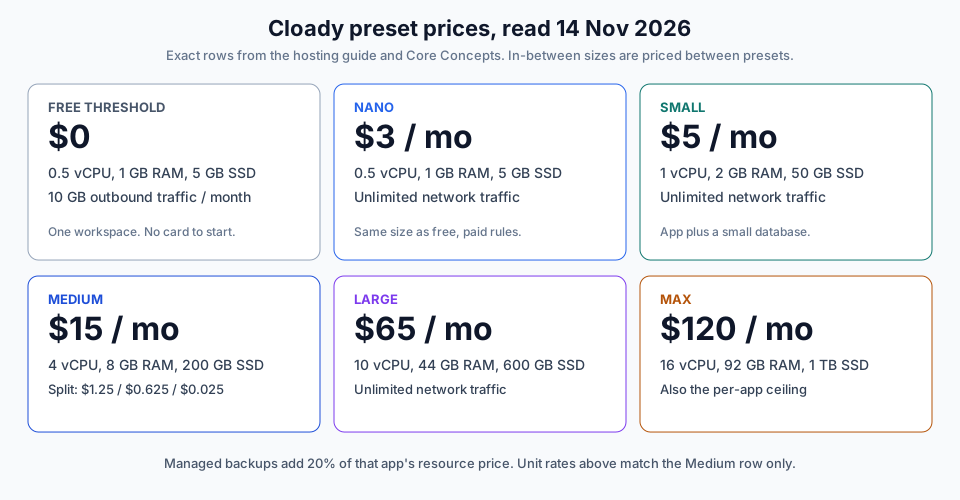
The hosting guide and Core Concepts print the same five presets. The free row below is the free-tier threshold, kept next to those presets because Nano has the same 0.5 vCPU, 1 GB and 5 GB shape at $3. Matching a preset on all three resources costs that preset's price. A size between two presets bills at the full price of the smallest preset that still covers CPU, RAM and disk together. Prices are the same in every region.
| Row | vCPU | RAM | SSD | Price / month | Network |
|---|---|---|---|---|---|
| Free threshold | 0.5 | 1 GB | 5 GB | $0 while inside the cap | 10 GB outbound |
| Nano | 0.5 | 1 GB | 5 GB | $3.00 | Unlimited |
| Small | 1 | 2 GB | 50 GB | $5.00 | Unlimited |
| Medium | 4 | 8 GB | 200 GB | $15.00 | Unlimited |
| Large | 10 | 44 GB | 600 GB | $65.00 | Unlimited |
| Max | 16 | 92 GB | 1 TB | $120.00 | Unlimited |
The homepage calculator, with Medium selected, splits that $15 into 4 vCPU at $1.25 ($5.00), 8 GB of RAM at $0.625 ($5.00) and 200 GB of SSD at $0.025 ($5.00). Cloudsoftzone presents those three rates as the general price list. Multiplying them by the Nano shape gives $1.375, and the Small shape comes out to $3.75, against published prices of $3.00 and $5.00. Those three rates hold only on the exact Medium row; a size between two presets bills at the smallest covering preset, as stated above.
Optional managed backups add 20% to the resource price of each app that has them on, and keep 7 daily restore points. The free-tier page says a free app has no nightly emergency backup, and turning managed backups on requires a card. The Terms of Service bill the workspace monthly through Stripe for declared capacity. An idle or stopped application keeps that capacity and that price. A larger size is charged immediately for the rest of the period. A smaller size waits until the next renewal. Fees are non-refundable except where the law requires a refund.
The homepage also compares a 4 vCPU, 8 GB, 200 GB shape with other hosts. Its own notes date those competitor prices to 19-27 September 2026. In that table Cloady is $15, the DigitalOcean droplet it names is $64, and Hetzner Cloud cpx42 is $82.59. Metered providers in the same table are estimated as if the machine stayed busy all month. That table is the vendor's comparison.
 🔍 View full resolution
Free allowance, monthly caps, and the trial-end conflict
The free threshold is 0.5 vCPU, 1 GB of RAM and 5 GB of SSD across every app in the workspace. Stay inside it and the workspace pays nothing. Cross any one of the three and the whole declared total is billed. An empty workspace costs nothing. The first deploy picks the plan. The Terms of Service allow several accounts and limit the free threshold to one person or one organization. The free-tier page says a workspace that has become paid cannot return to free. Core Concepts adds that the free slot can move to another workspace that still fits, the one with the oldest app.
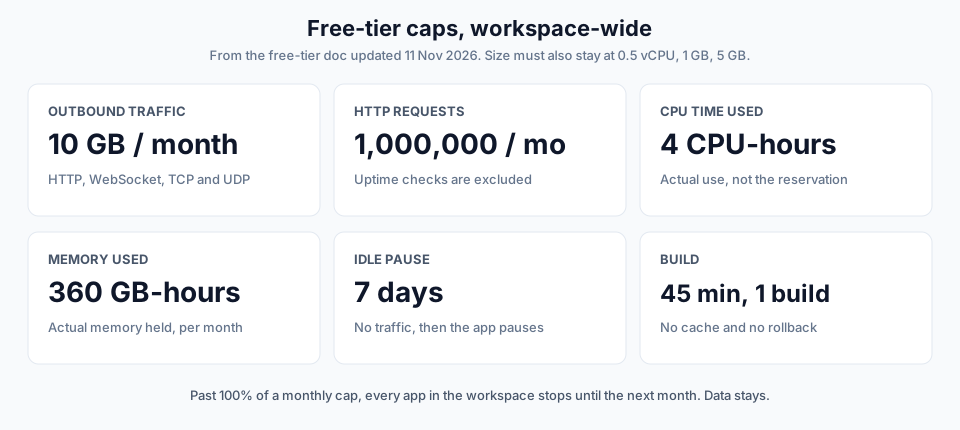
On top of the size threshold, the free tier and free trial page caps the whole free workspace:
| Cap | Free tier | What counts |
|---|---|---|
| Traffic | 10 GB / month | Everything the apps send, including WebSocket, TCP and UDP |
| HTTP requests | 1,000,000 / month | Requests to the apps. Uptime checks are excluded |
| CPU | 4 CPU-hours / month | CPU time actually used, not the amount reserved |
| Memory | 360 GB-hours / month | Memory actually held, times the hours it is held |
| Build time | 45 minutes | A build still running at 45 minutes fails |
| Builds at once | 1 per workspace | The next deploy waits. No build cache, no rollback |
| Connections | 1,000 per address | Further requests get HTTP 429. Apps stay up |
| Idle | 7 days without traffic | The app pauses. Start brings it back |
At 90% of a monthly cap, members get one email that month. Past 100%, Cloady stops every app in the workspace within a few minutes and keeps data, settings and addresses. Starting an app again before the month rolls over gets it stopped again. It can run from the first day of the next month. Past 1,000 simultaneous connections on one address, new requests receive HTTP 429 and the apps stay up. After 7 days without traffic a free app pauses. When a free app built from source has been stopped for 3 days, its image is deleted and the next start is a full rebuild. Free-tier compute is shared. The workspace has a single member, the owner. vpslu.com's 9 November signup used an email code, with no separate password step and no phone number, and the new workspace landed on Japan, a trial region that day and still marked trial on 14 November.
The free trial is a different plan. In regions that offer it, the first small workspace (same 0.5 vCPU, 1 GB, 5 GB envelope) runs for one month, once per account, with no card required to start. Trial apps get the same compute, monitor and nightly emergency backups as a paid app. The monthly caps and the 7-day pause stay off. The shared limit is 1,000 connections per address. Growing past the size envelope during the trial bills the whole workspace. An app whose cloady.json sets type to dedicated never receives the free tier or the trial. Deleting the trial workspace does not hand the month back.
The three official descriptions of the day the trial ends disagree. The free tier and free trial page, updated 11 November 2026, says that if every app sits in a free-tier region the workspace returns to the free tier and keeps running under the free caps. In any other region the apps stop, the data stays, and nothing is charged until a paid upgrade. The hosting guide and Core Concepts, both updated 5 November 2026, say that a card on file keeps the app running at the normal monthly price, and that without a card the app stops and keeps its data. The official homepage FAQ notes that apps stop and retain their data after the trial month until the workspace is upgraded. The 11 November page is the newest page written for this rule. The homepage FAQ still describes a stop. Read that section again on the day the fallback matters.
The only timed deploy in the sources above is vpslu.com on 9 November: the Nginx catalog template in USE1, which that article puts at about 0.1 vCPU and 0.13 GB of RAM, reached live in 14 seconds with TLS. The billing page showed $0.00 for the current month, the amount due today, and next month. The console showed live CPU and memory (16m of 100m CPU, 6 MB of 133 MB RAM while idle) and showed no gauge for the monthly caps. The same article says the region picker inside the console carries no free or trial badge, aside from Singapore marked out of stock. A chinaz multi-node ping that morning, cited there, averaged 224.9 ms across 24 China Telecom nodes to the US East address, with 4 China Unicom nodes averaging 237.0 ms. That sample is ping latency, measured once.
 🔍 View full resolution
Which preset fits which workload
Free tier: one workspace, apps that together stay at or under 0.5 vCPU, 1 GB and 5 GB, and outbound traffic kept under 10 GB a month. On 14 November the regions marked free were EU1, USE1 and USW1. That covers a small site, a bot or a low-traffic API that can pause after 7 quiet days. There is no rollback, no second member, and no nightly emergency backup unless managed backups are turned on, which needs a card.
Nano at $3 a month: the same 0.5 vCPU, 1 GB and 5 GB shape, once the app needs unlimited traffic, a region that currently offers only the trial, more than one member, or a process that must stay up through a quiet week. Paying removes the free-tier monthly caps. The terms still charge declared capacity while the app is idle or stopped, until a decrease takes effect at the next renewal.
Small at $5 or Medium at $15: an application and its database that together need more than the free shape. Count every service. A database that sits idle still reserves the CPU, RAM and disk it declares. Medium's published point is 4 vCPU, 8 GB, 200 GB and unlimited network at $15. Managed backups on a single app that sits exactly on that preset add $3 a month (20% of $15). Large is $65 for 10 vCPU, 44 GB and 600 GB. Max is $120 for 16 vCPU, 92 GB and 1 TB, which is also the per-app ceiling.
A VPS, or a host that meters quiet hours: the job needs a general Linux machine, or a bill that falls when the process is idle. Cloady sells declared capacity, and the shell is per service. For readers in mainland China, the 224.9 ms Telecom ping to US East on 9 November is one sample. Germany (EU1) was on the free list on 14 November. Singapore was closed to new apps that day.
A second workspace is paid even when it is small. Before a production cutover, re-check the region plan on the deploy page and the trial-ending section of the free tier and free trial page, because those official texts still disagree. Product home: cloady.com. Preset prices: hosting guide. Free caps: free tier and free trial.