What Shipped on November 12
Google introduced Gemini 4 Hydrogen (model ID gemini-4-hydrogen) on November 12, 2026, positioning it as the everyday workhorse for coding agents and high-volume request loops; benchmark leadership stays with Carbon. It takes over the lightweight default slot from Gemini 3.8 Flash.
Distribution is wide from day one: Google AI Studio, the Gemini API, the Gemini app, Google Search, and Gemini for business all carry it. Paid Google AI Pro and Ultra subscribers get it in Google Antigravity, and free Gemini app users meet it through Auto model selection when Google judges it the right fit for a prompt. The announcement post and the AI Studio changelog are the two primary sources for everything below.
The model carries a unified 1,048,576-token context window shared by input, intermediate thinking, and output, handles text, image, audio, and video input, and Google's own model card lists fabricated answers, occasional slow or unfinished runs, and heavier token burn at aggressive thinking settings among its limitations.
Pricing: One Flat Rate Across a Million Tokens
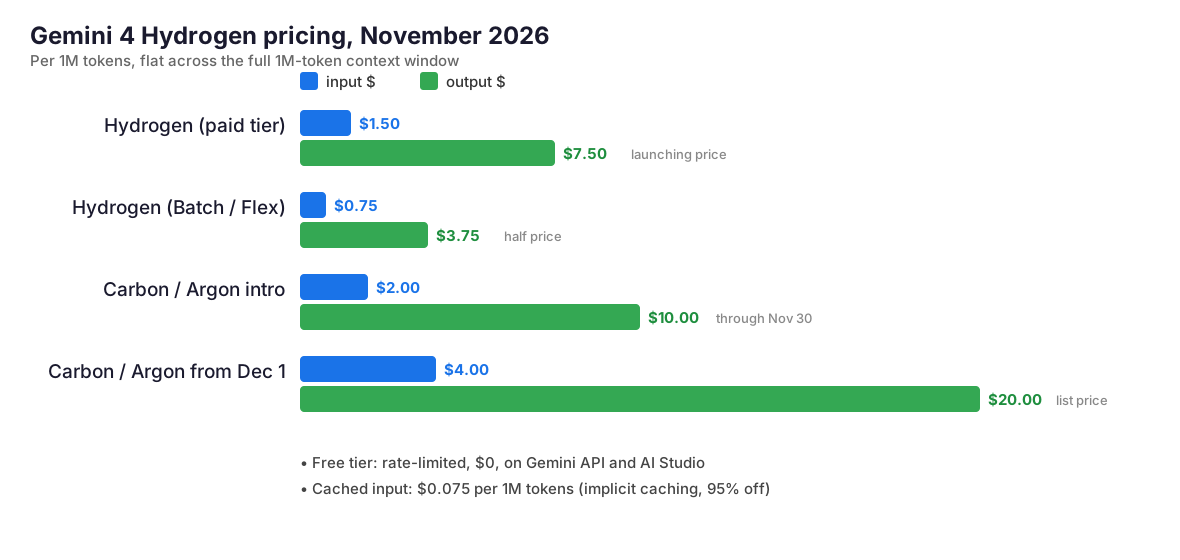
The headline is a single flat price with no context-length tiers: $1.50 per million input tokens and $7.50 per million output, valid across the entire 1M-token window. Cached input drops to $0.075 per million tokens through implicit caching, a 95% discount that matters a lot for agent loops that resend long system prompts hundreds of times a day.
For comparison, Gemini 4 Carbon and Argon currently sell at an introductory $2 per million input and $10 per million output; that price steps up to $4 and $20 after the introductory period ends on November 30, 2026. Hydrogen also has a Batch and Flex lane at exactly half price: $0.75 in, $3.75 out.
 🔍 View full resolution
| Lane | Input / 1M tokens | Output / 1M tokens | Free tier |
|---|---|---|---|
| Hydrogen, standard | $1.50 | $7.50 | Yes, rate-limited |
| Hydrogen, cached input | $0.075 | $7.50 | Yes, rate-limited |
| Hydrogen, Batch / Flex | $0.75 | $3.75 | No |
| Carbon / Argon, intro | $2.00 | $10.00 | No |
| Carbon / Argon, from Dec 1 | $4.00 | $20.00 | No |
Try it: aistudio.google.com (free, rate-limited access to gemini-4-hydrogen in Google AI Studio)
Four Thinking Levels, Including a New xhigh Gear
Hydrogen is the first Gemini model with four thinking levels: low, medium, high (the default), and a new xhigh tier for problems where high still falls short. Google's guidance is explicit that xhigh raises latency and token use and can cause overthinking on simpler prompts, so the recommendation is to benchmark your own workload at all four levels and pick the lowest one that clears your quality bar.
| Thinking level | Token use | Best suited for |
|---|---|---|
| low | Fewest tokens, lowest latency | Cost-sensitive chat and high-throughput processing |
| medium | Lower token use, faster responses | Interactive coding, live UI prototyping, latency-sensitive tool calls |
| high (default) | Balanced | Complex coding, agentic execution, tool calling, multimodal work |
| xhigh | Most tokens, deepest reasoning | Hard multi-step problems where high falls short |
Two design details are worth noting for API users. Hydrogen defaults to high, while Carbon and Argon default to medium and cap at high, so porting an existing pipeline means re-checking the thinking level rather than assuming parity. Hydrogen also rejects the minimal level with an error, a difference that will surface the moment an old config hits the new model.
Orchestrator in Antigravity: Two Models, One Session
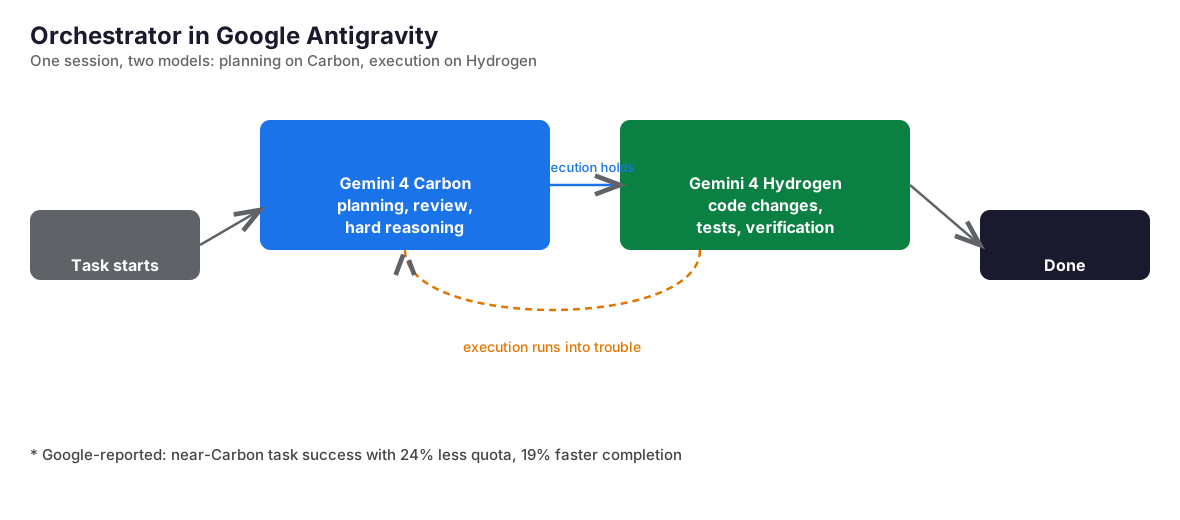
Alongside the model, Google shipped Orchestrator, a coordination mode in Antigravity that moves a task between models while it runs. Carbon handles planning and review, Hydrogen takes code changes, tests, and verification, and control passes back to Carbon if execution hits trouble. The choice of model follows the work as it moves through stages.
 🔍 View full resolution
Google's Antigravity team reports that this mixed-model approach reached near-Carbon task success on Terminal-Bench 4.1 while using 24% less quota and finishing 19% faster on average. Those are the team's own benchmark numbers, published at launch and not yet reproduced by third parties. Availability is staged: Orchestrator starts with AI Ultra subscribers, Hydrogen reaches paid Pro and Ultra tiers in Antigravity, and enterprises get both through Gemini for business.
The Third-Party Scoreboard on Launch Day
Artificial Analysis measured Hydrogen at all four thinking levels on launch day. The spread is the interesting part: xhigh lands at 53.9 on the Intelligence Index, close to Carbon's 60.0 at its own high setting, while the default high level posts 50.8, essentially level with Argon's 50.4. The previous lightweight default, Gemini 3.8 Flash, measures 30.8 at high.
| Model and thinking level | AA Intelligence Index |
|---|---|
| Gemini 4 Carbon (high) | 60.0 |
| Gemini 4 Hydrogen (xhigh) | 53.9 |
| Gemini 4 Hydrogen (high, default) | 50.8 |
| Gemini 4 Argon (high) | 50.4 |
| Gemini 3.8 Flash (high) | 30.8 |
Attribution matters here: the 51 / 50 / 54 integers are Google quoting the Artificial Analysis index, while AA's own launch-day run measured 50.8 at default high and 53.9 at xhigh, against Carbon's 60.0. On those numbers a $1.50-input model lands within roughly six points of a $2-input frontier model at xhigh, and level with Argon at the default setting. That reshapes the default math for agent fleets ahead of the Carbon price step-up on December 1.
Which One Should You Actually Call
Choose Hydrogen if: you run agents, coding loops, or chat backends that fire many small requests. It is the only model in the Gemini 4 family with a free API tier, its $1.50 / $7.50 flat pricing survives the full 1M context, and Batch or Flex halves the bill for offline workloads.
Choose Carbon if: your workload needs the highest reasoning ceiling regardless of cost. It still leads the launch-day measurements at 60.0, and the introductory $2 / $10 pricing holds through November 30 if you can front-load heavy work into that window.
Skip the migration if: your pipeline hard-depends on the minimal thinking level or on Carbon-and-Argon's medium default. Hydrogen rejects minimal outright, and assuming a level-for-level port will silently change both cost and quality profiles.