A closed question has a published price
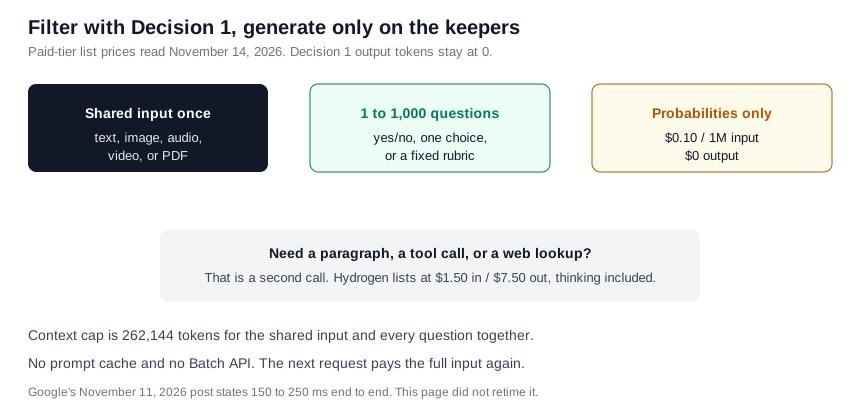
Gemini Decision 1 (gemini-decision-1) scores closed questions and returns probabilities. Google's November 11, 2026 post introduces the endpoint. The Gemini API pricing page, read November 14, 2026, puts the paid tier at $0.10 per million input tokens. Output tokens are listed as not applicable, because the count stays at 0. The free tier is also free of charge, and the same table marks free-tier content as used to improve Google's products. The paid row is marked unused for product improvement.
The Decisions API guide allows 1 to 1,000 questions on one shared input. Yes/no answers come back as a probability from 0.01 to 0.99 plus a confidence score. A choice question takes 2 to 255 options. A rubric takes 2 to 255 ordered levels. The model page caps the context at 262,144 tokens, and that budget covers the shared input plus every question. Questions are scored separately: one question does not see the others.
 🔍 View full resolution
Google's November 11 post states end-to-end latency of 150 to 250 milliseconds. That latency figure is the one in Google's post. Nobody retimed it for this comparison. The guide's quickstart asks for SDK 3.2 or later. A safety block comes back as HTTP 400 with no answer object. The docs name codes such as safety, prohibited_content, blocklist, image_safety, and content_blocked.
Try it: aistudio.google.com/docs/decisions-api
Try it: aistudio.google.com/welcome
What $0.10 does not include
The guide says only input tokens are billed. Shared input is billed once no matter how many questions ride along, and each question adds its own instruction and criteria tokens. Video frames and PDF pages count as image tokens. The endpoint does not support context caching, Batch API, Flex inference, or Priority inference. A repeated document on the next request is a new full input bill. YouTube URLs and gs:// links are rejected. Search grounding is listed as not supported on the model page, so this call does not look anything up on the web.
| Paid tier, read Nov 14, 2026 | Decision 1 | Gemini 4 Hydrogen | Haiku 5.5, prompt at most 100k |
|---|---|---|---|
| Input / 1M tokens | $0.10 | $1.50 | $0.10 |
| Output / 1M tokens | $0, token count stays 0 | $7.50, thinking tokens included | $0.50 |
| Cache | Not supported | Implicit cache $0.075 / 1M | Cache read $0.01 / 1M on this row |
| Context | 262,144 tokens, questions included | 1M-token window on the model card | 1M tokens, higher price after 100k prompt tokens |
| Returns | Probabilities for a closed set | Generated text | Generated text |
Hydrogen's free tier is also free of charge and marked as used to improve products. Its paid output price includes thinking tokens, so a long hidden trace is not a separate line item. It is more output tokens at $7.50 per million. Haiku's $0.10 / $0.50 row applies only when the whole prompt, cache reads included, stays at or under 100,000 tokens. Details of that split are in the Claude pricing comparison published alongside this note.
100 files is $0.20 before the questions
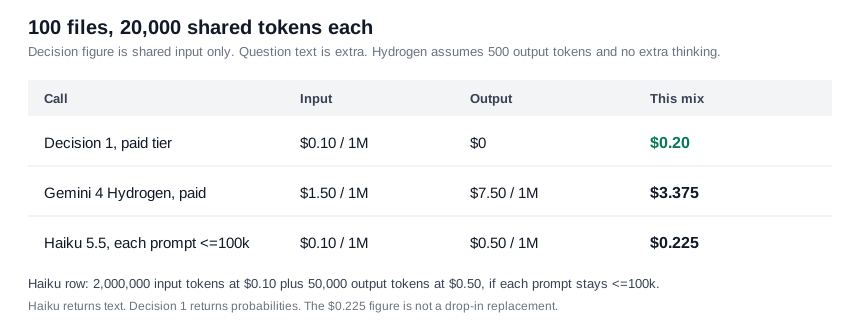
Take 100 documents, 20,000 shared tokens each. That is 2,000,000 input tokens. At $0.10 per million, the shared-input slice is $0.20. Question text sits on top of that $0.20. The docs do not publish a flat token count for a question, so this page does not invent one. On a short email, the question can rival the source. On a 20,000-token PDF, the source is the larger line.
Send those same 100 documents to paid Hydrogen and allow 500 output tokens each, with no extra thinking tokens. Input is 2,000,000 / 1,000,000 x $1.50 = $3.00. Output is 50,000 / 1,000,000 x $7.50 = $0.375. The call lists at $3.375. Any thinking tokens raise the output side above $0.375.
Haiku 5.5 on the short row, with the same 500 generated tokens per file, is 2,000,000 x $0.10 / 1,000,000 = $0.20 of input plus 50,000 x $0.50 / 1,000,000 = $0.025 of output, so $0.225. A 20-token label instead of a 500-token paragraph drops the output side to about $0.001. Haiku and Decision 1 are close on a short prompt. They do not return the same object: one returns text you still have to parse, the other returns a probability you can threshold.
 🔍 View full resolution
Where to put the $0.10 call
Choose Decision 1 if: the next step in code is a threshold. Routing a ticket, checking a policy list, grading a retrieved chunk, or picking one tool from a fixed set fits the three question types. Put the shared PDF in once and ask the closed questions together. Keep payouts, deletes, and other hard-to-undo actions behind a second check. The guide tells you to treat user text as untrusted, because the text can argue for its own label.
Choose Gemini 4 Hydrogen if: you need a paragraph, a summary, or a multi-step answer. Decision 1 will not write it. Budget $1.50 per million input tokens and $7.50 per million output tokens on the paid tier, and remember that thinking tokens count as output. Grounding with Google Search is a separate meter: the pricing page lists 5,000 free search requests a month across Gemini 3 and newer models, then $14 per 1,000, with a default daily cap of 1,500 requests.
Choose Haiku 5.5 if: you need a short written label and you can keep each prompt at or under 100,000 tokens. On that row the list price matches Decision 1 on input ($0.10) and adds $0.50 per million output tokens. Claude prompt caching can cut a repeated prefix. Decision 1 cannot. A Perplexity or ChatGPT web lookup is a third product with its own plan: Decision 1 does not search.
The pricing figures and tier boundaries above are derived from the official Gemini API pricing matrix, the Decisions API documentation, and Claude's standard published rate cards.