Why a General Chatbot Is Not Enough for Math Practice
Ask a general chatbot to solve a homework problem and it will usually produce the right answer fast. But the solution scrolls away and nothing follows: the mistake patterns behind it are never recorded, and next week the same chapter feels new again. Dedicated math tools are built around a different loop: they keep the problem and the wrong turns, then turn both into review material.
Mathos AI (listed by third-party directories as the rebrand of MathGPT Pro, from a Y Combinator W24 batch) is one of these dedicated solvers. It accepts photos, typed equations or PDF homework, solves step by step with automatically drawn graphs, and lets you choose between a single hint or the full derivation. Any solution can be converted into quizzes, flashcards or a narrated explainer video in about a minute. This guide lays out a five-step workflow that uses those pieces in a sensible order, with quotas and prices verified on the official pricing page on November 10, 2026.
The Five-Step Workflow: From Photo to Weekly Review
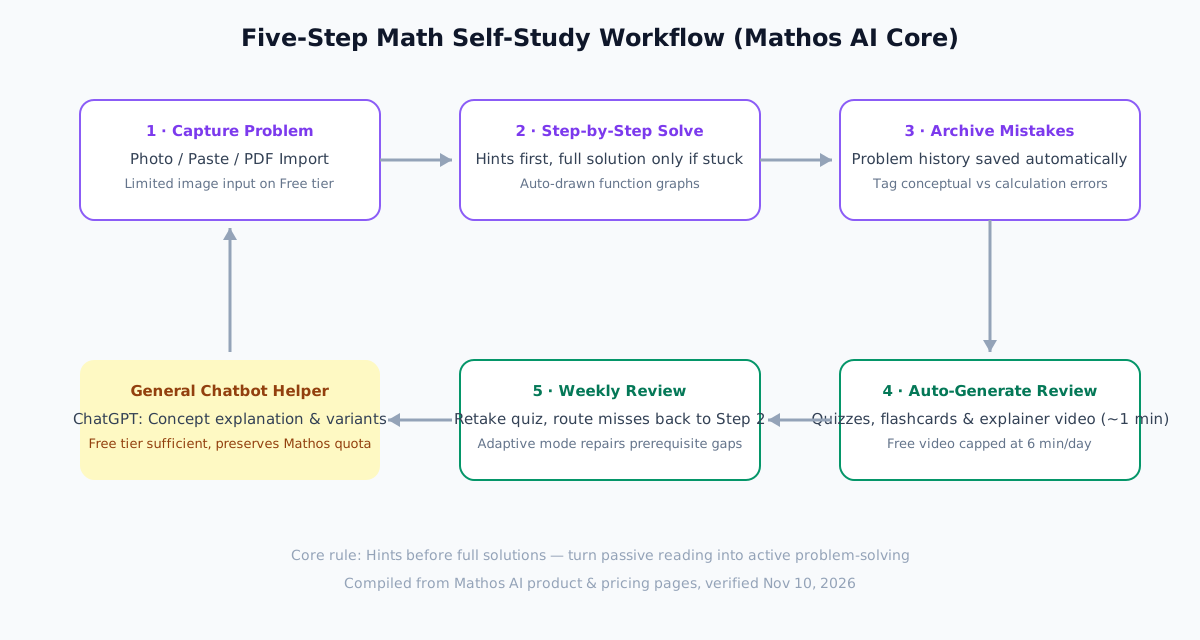
Step 1 is capture: photograph the problem or import the PDF; the free tier allows limited image input, so batch your captures. Step 2 is solving, and the rule that matters most is hints first. Request a hint, attempt the step yourself, and only open the full derivation when you are genuinely stuck. Mathos draws graphs automatically, which saves real time on functions and geometry. Step 3 is archiving: the question history keeps every problem, so tag the ones you missed and note whether the error was conceptual or computational.
 🔍 View full resolution
Step 4 is where the tool earns its keep: feed missed problems into quiz, flashcard or video generation. The free plan includes flashcards and quizzes with 6 minutes of video per day; paid plans raise the video quota to 15 minutes per day on Basic and 30 on Prime. Step 5 is the weekly review: retake the generated quiz, and route anything you miss back to step 2. The adaptive mode studies your error patterns and revisits missing prerequisites, which is the part a notebook of raw mistakes can never do on its own.
Quotas and Pricing: Free Tier, Basic, Prime
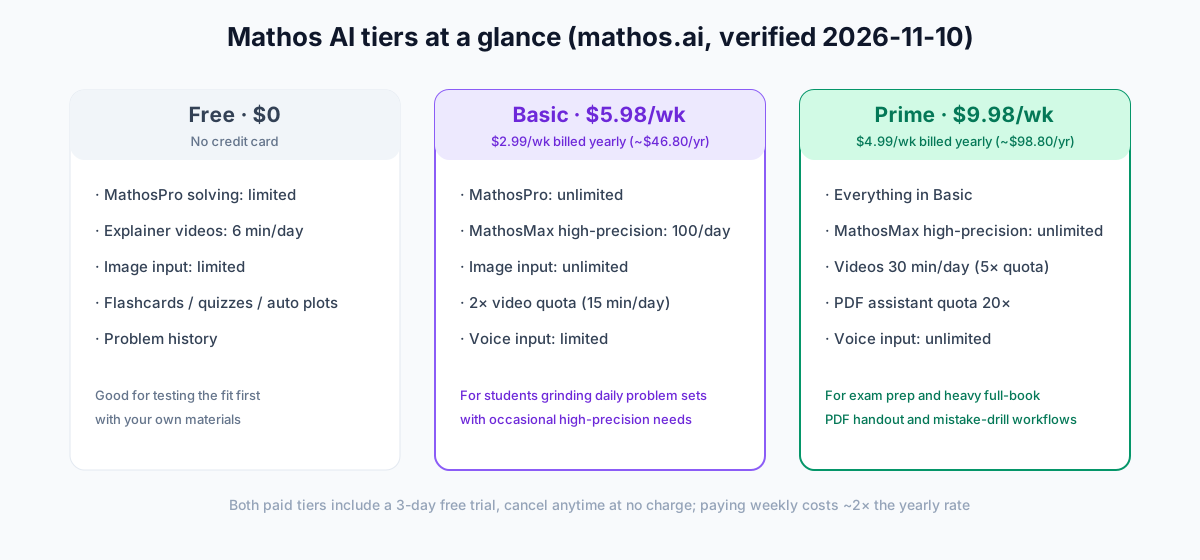
The free plan is usable as a permanent baseline: limited MathosPro solving, 6 video minutes per day, limited image input, plus flashcards, quizzes, auto-drawn graphs and question history at no cost and with no card required. Basic lists at $5.98 per week, with annual billing totaling $46.80 per year (about $0.90 per week); the pricing page also shows a limited-time weekly rate of $2.99 with no stated end date adds unlimited MathosPro, 100 runs per day of the higher-accuracy MathosMax model, unlimited image input and 15 video minutes per day. Prime lists at $9.98 per week with annual billing at $98.80 per year (about $1.90 per week; limited-time weekly rate $4.99) removes the MathosMax cap, raises video to 30 minutes per day, multiplies the PDF helper quota by 20 and adds unlimited voice input. Both paid plans open with a 3-day free trial, and weekly billing without the annual commitment runs about twice the advertised rate.
 🔍 View full resolution
| Quota | Free ($0) | Basic ($5.98/wk) | Prime ($9.98/wk) |
|---|---|---|---|
| MathosPro solver | Limited | Unlimited | Unlimited |
| MathosMax high accuracy | Not included | 100 per day | Unlimited |
| Explainer video | 6 min/day | 15 min/day | 30 min/day |
| Image input | Limited | Unlimited | Unlimited |
| Voice input | Not included | Limited | Unlimited |
| PDF helper quota | Base | Base | 20x |
For context on the general-purpose alternative: ChatGPT Plus costs $20 per month and includes strong step-by-step reasoning, but it stores no mistake archive, generates no flashcards, and its explainer output is text you would have to format yourself. At Prime's annual rate of roughly $8.23 per month, the dedicated tool costs less than half of the general subscription while doing the parts the chatbot skips.
Which Setup Fits Your Situation
Stay on the free tier if: you solve fewer than about ten problems a day and mainly want solution checking. The 6 video minutes per day are enough for one or two explainer clips on the day's hardest mistake.
Choose Basic if: exam season means high daily volume and MathosMax's 100 daily high-accuracy runs cover your hardest problems. Annual billing at about $2.99 per week is the sensible rate; skip weekly billing unless you truly need one month only.
Choose Prime if: you work through full PDF lecture notes, want unlimited high-accuracy solving, or learn better from narrated videos than from text. The 20x PDF helper quota is the feature that separates Prime from Basic in real use.
Pair with ChatGPT if: your gap is conceptual, not procedural. Ask the general chatbot to explain the underlying theorem or to generate variant problems, then bring the variants back into Mathos for graded practice and review material.
Try it: mathos.ai/pricing
Sign-up: chatgpt.com