Positioning: A Cloud Engineer or a UI Generator
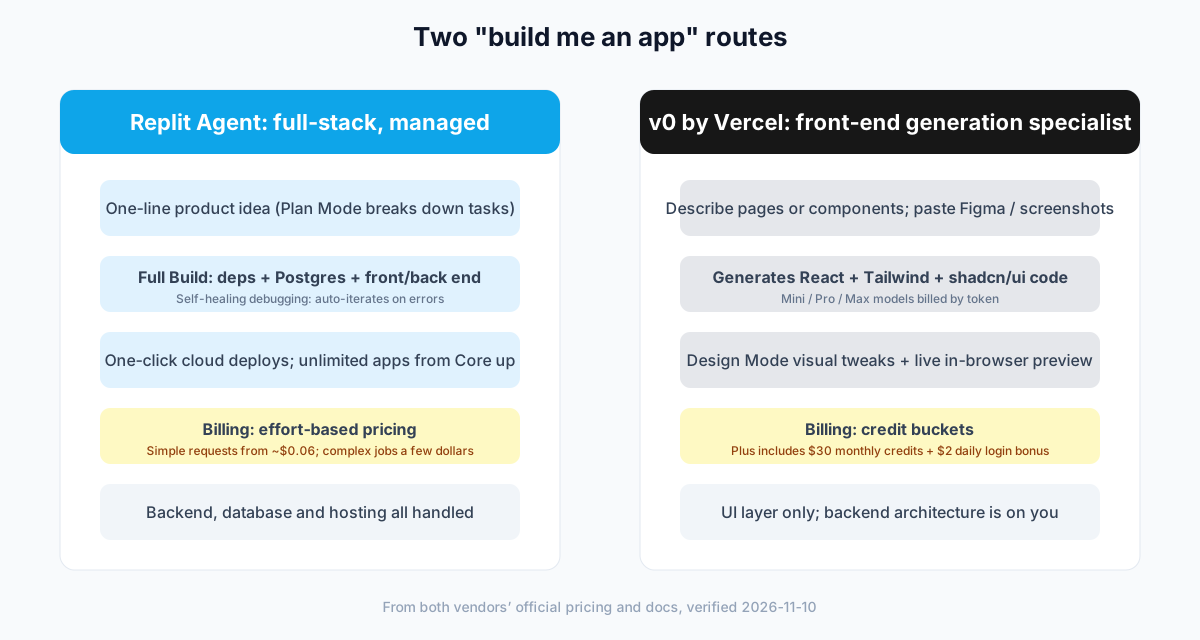
Both tools promise to turn a sentence into working software, but they stop at very different layers. Replit Agent runs inside a hosted cloud workspace: it plans a task, installs npm or pip packages, provisions a Postgres database, writes backend and frontend code, then deploys the result. Plan Mode lets you review the breakdown before any code is written, and Full Build hands the whole implementation to the agent. v0 by Vercel works at the interface layer: you describe a page or paste a design, and it returns React components styled with Tailwind CSS and shadcn/ui, with a Design Mode for visual tweaks and one-click sync to a GitHub repo or a Vercel deployment.
 🔍 View full resolution
This comparison relies on each vendor's official pricing pages and product documentation, verified on November 10, 2026. Prices are list prices in USD before tax; both vendors change plans often enough that you should re-check before paying annually.
Pricing: Effort-Based Checkpoints vs Credit Buckets
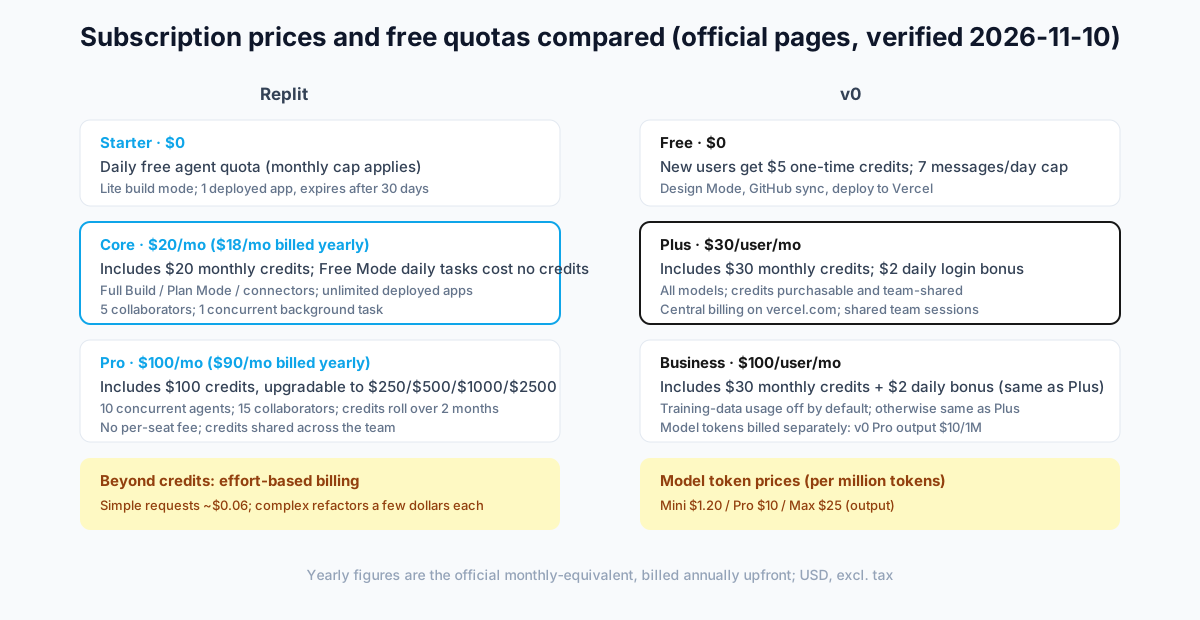
Replit prices agent work by effort. Each request becomes one checkpoint, and its cost reflects the time and compute the agent consumed: simple fixes have landed around $0.06, while complex tasks can run past $1 and, per Replit's own pricing recap, occasionally to several dollars. Core costs $20 per month ($18 per month billed annually) and includes $20 of monthly credits plus a Free Mode allowance for everyday agent work that does not touch credits; Pro starts at $100 per month ($90 annually) with $100 of credits, up to 10 parallel agent tasks and 15 collaborators.
 🔍 View full resolution
v0 buckets usage into dollar-denominated credits. The Free plan gives new users $5 in one-time credits with a 7-message daily limit. Plus costs $30 per user per month and includes $30 of monthly credits plus $2 of free daily credits on login; Business at $100 per user per month keeps the same credit package and adds training opt-out by default. Model usage is metered in tokens on top of plan limits: v0 Mini outputs at $1.20 per million tokens, v0 Pro at $10, and v0 Max at $25.
| Dimension | Replit | v0 |
|---|---|---|
| Free tier | Starter: daily agent credits with a monthly cap, Lite build mode, 1 published app that expires after 30 days | Free: $5 one-time credits, 7 messages/day, Design Mode, GitHub sync, deploy to Vercel |
| Entry paid plan | Core: $20/mo ($18 annual) with $20 credits, Free Mode allowance, unlimited published apps, 5 collaborators | Plus: $30/user/mo with $30 credits plus $2 daily login credits, all models, team credit sharing |
| High tier | Pro: from $100/mo ($90 annual) with $100 credits, 10 parallel agents, 15 builders, 2-month credit rollover | Business: $100/user/mo, same credit package, training opt-out by default |
| Usage metering | Effort-based checkpoints: about $0.06 for simple requests, several dollars possible on complex tasks | Credits per plan plus token rates: v0 Mini $1.20, v0 Pro $10, v0 Max $25 per 1M output tokens |
| Scope | Full stack: dependencies, Postgres, auth, deployment, background tasks | Frontend: React, Tailwind, shadcn/ui components and pages, deploy to Vercel |
Two practical notes on cost. First, Replit's effort-based model makes monthly bills less predictable: after Agent 3 launched in September 2025, The Register reported users whose charges jumped sharply when the agent spawned sub-agents to review and fix large existing codebases. Second, v0's daily login credits reward habitual use; if you build twice a month, the $2-per-day bonus mostly goes unused, and the $30 monthly fee spreads across so few projects that the effective per-project cost climbs well above the headline rate.
Capability Boundaries: Where Each Tool Stops
Replit's coverage is wide but its interface output is generic; expect to restyle whatever the agent scaffolds. Its strength shows up on the plumbing side: connectors for services such as Google and Stripe, scheduled background tasks (1 on Core, 10 on Pro), database restore windows, and unlimited published apps from Core upward. Collaboration is built in, with 5 seats on Core and 15 on Pro, and credits are pooled rather than charged per seat.
v0's boundary is the opposite. It produces clean, accessible React code that follows shadcn/ui conventions, previews changes instantly in the browser, and syncs with GitHub, but it will not design your schema, wire payments, or run a cron job. Teams that adopt v0 usually pair it with a separate backend stack, which is why Vercel positions it as a complement to a codebase rather than a replacement for one.
Final Verdict: Which Should You Choose?
Choose Replit Agent if: you are a solo founder or product manager shipping a data-backed MVP without a backend engineer. Core at $20 per month with unlimited published apps is one of the lowest-cost ways to hold a real full-stack project in one place, and Plan Mode keeps large builds reviewable.
Choose v0 if: your product already has a backend and your bottleneck is interface velocity. Plus at $30 per user pays for itself in a day of saved frontend churn, and Design Mode keeps designers in the loop without Figma handoff overhead.
Run both if: you are validating a new product: prototype the UI in v0's free tier, then hand the approved screens to Replit Agent for the backend and hosting. Budget a month on monthly billing before any annual commitment so you can read your own usage graph first.
Sign-up: replit.com/pricing
Sign-up: v0.app/pricing