How the two models are positioned
 🔍 View full resolution
Both Claude Fable 5.2 and Claude Opus 5.5 are in Anthropic’s current model catalogue. Officially, they are meant for different jobs.
| Item | Claude Fable 5.2 | Claude Opus 5.5 |
|---|---|---|
| Released | 9 November 2026 | 22 September 2026 |
| API ID | claude-fable-5-2 | claude-opus-5-5 |
| Official role | Demanding reasoning and long-horizon agents | Long-running agentic coding and knowledge work |
| Official starting advice | Step up when Opus is not enough | Start here for most work; “strongest daily driver” |
| Comparative latency (vendor wording) | Moderate | Moderate |
| Context / max output | 1M / 128K tokens | 1M / 128K tokens |
| Reliable knowledge / training cutoff | June 2026 / June 2026 | June 2026 / June 2026 |
| Thinking | Adaptive, always on | Adaptive, always on |
| Default API effort | high | medium |
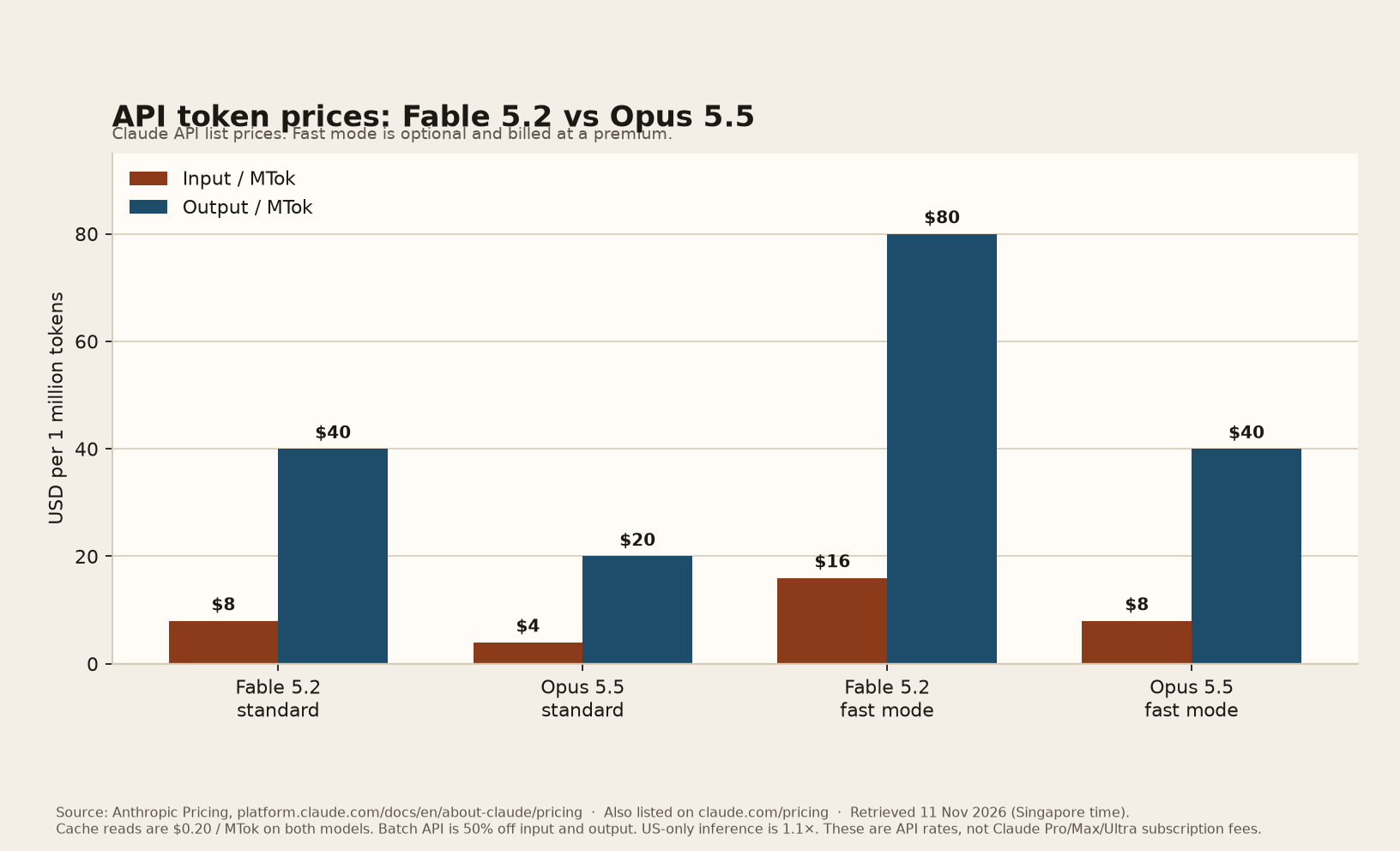
| Standard API price (per million tokens) | $8 input / $40 output | $4 input / $20 output |
| Fast mode | $16 / $80 | $8 / $40 |
| Cache reads | $0.20 | $0.20 |
| Batch API | 50% off | 50% off |
| Retirement not sooner than (Anthropic-run platforms) | 9 November 2027 | 22 September 2027 |
Fable and Mythos 5.2 share the same core foundation, but Fable includes broader safeguards for public deployment while Mythos remains restricted to specialized safety verification programs.
Fable also has a fallback that is easy to miss. When its cybersecurity classifier blocks a request, the response can come from Opus 4.8; biology blocks can fall back to Opus 5. If your work sits near those lines, the experience may not match a leaderboard row.
Subscriptions and the API are different bills
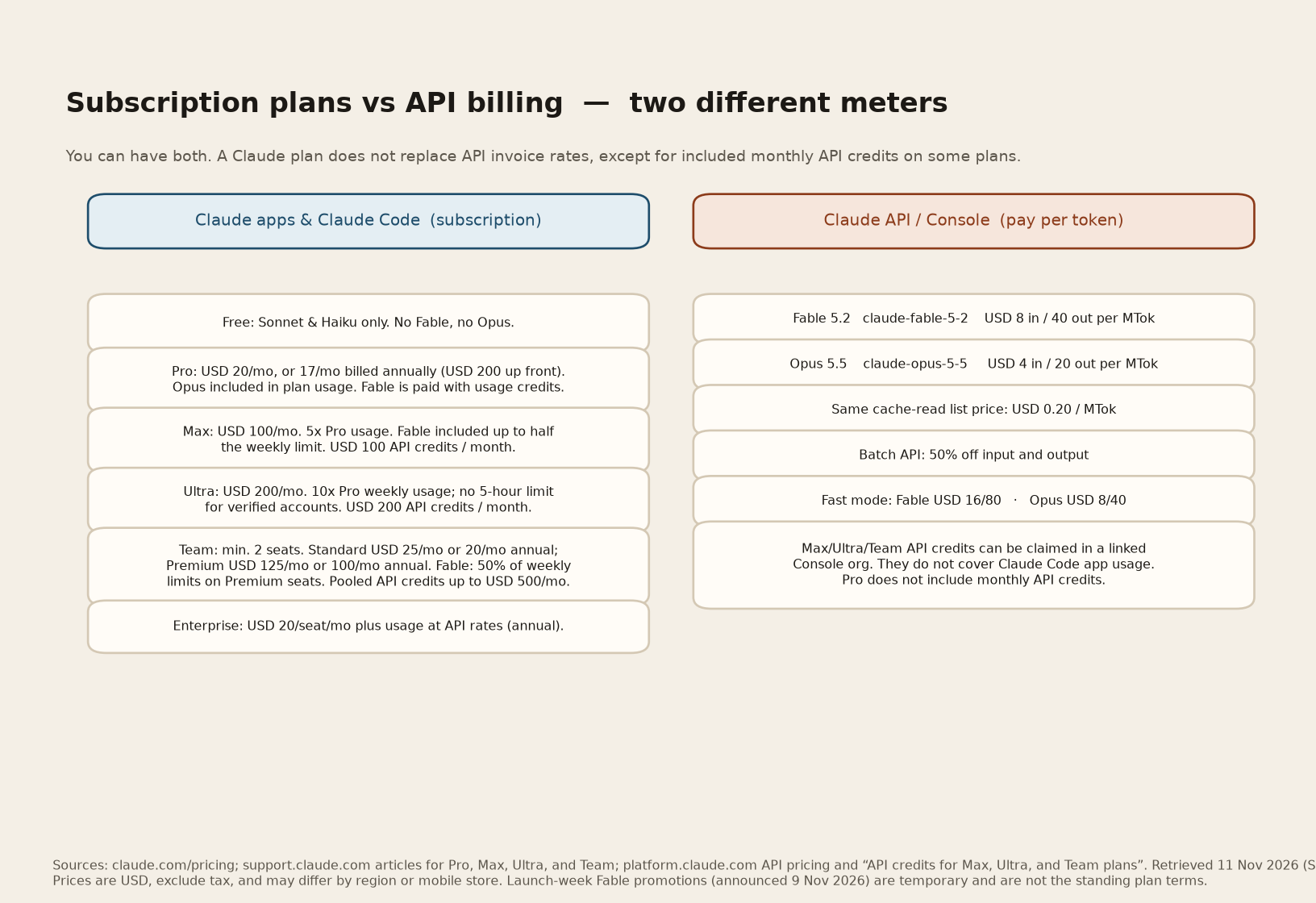
Do not mash these together. A Claude plan meters usage in the apps and in Claude Code. The API is billed per token. Some plans add monthly API credits, but those credits go to a linked Claude Console organization. They do not cover extra usage inside Claude Code on the subscription meter.
 🔍 View full resolution
Individual plans, from claude.com/pricing and the help center, in USD, excluding tax. Regional and mobile-store prices can differ.
- Free: Sonnet and Haiku. No Fable, no Opus.
- Pro: $20 a month, or $17 a month if you pay $200 annually up front. Opus is included in plan usage. Fable is paid with usage credits.
- Max: $100 a month, with 5× Pro usage. Fable is included for up to half of the weekly limit. The plan also includes $100 a month in API credits.
- Ultra: $200 a month, with 10× Pro weekly usage and no five-hour limit for verified accounts. It includes $200 a month in API credits.
Team plans need at least two seats. Standard seats are $25 a month, or $20 a month billed annually. Premium seats are $125 a month, or $100 a month billed annually. The pricing page says Fable is 50% of weekly limits on Premium seats. Monthly API credits are pooled and capped at $500.
Enterprise, according to the pricing FAQ, is $20 per seat per month plus usage billed at API rates, on an annual contract. Treat that as the published starting point, not a negotiated quote.
Max, Ultra, and Team API credits have to be claimed after you link a Console org. They expire at the end of the cycle and do not roll over. Pro does not include this monthly API credit.
Promotional allowances during launch windows may adjust quotas temporarily; always verify active parameters in official workspace settings.
On the API itself, Fable’s standard rate is twice Opus. Fable’s fast mode ($16 / $80) is twice Fable’s standard rate, and twice Opus’s fast mode. Cache reads are $0.20 per million tokens on both models — 2.5% of Fable’s base input price, 5% of Opus’s. US-only inference is billed at 1.1×. Cloud marketplaces can add their own regional premiums.
A simple check: one million input tokens plus one million output tokens costs $48 on Fable and $24 on Opus, at standard rates, before you count the extra thinking tokens that higher effort usually produces.
Vendor benchmarks: Fable leads most rows, with one useful exception
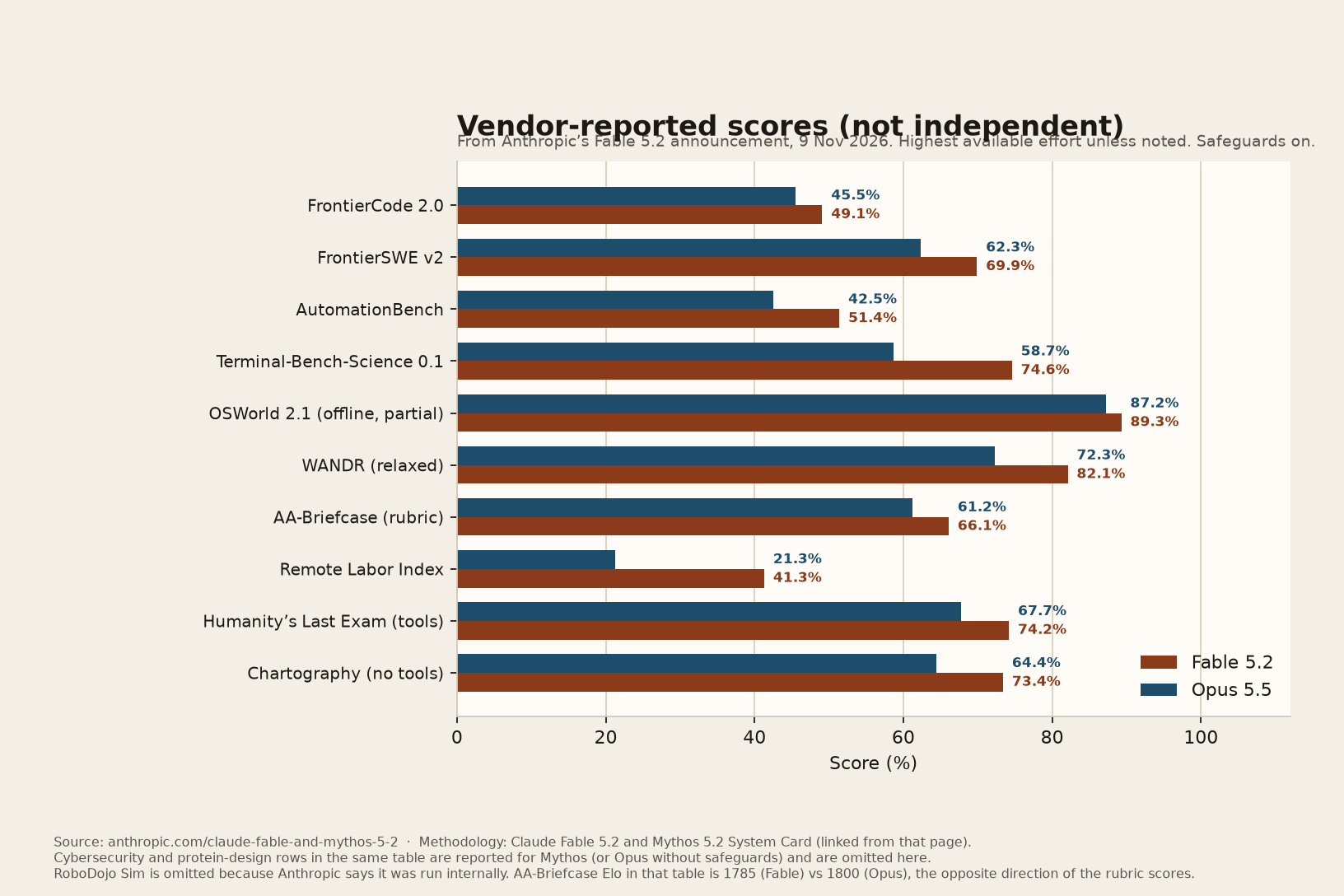
Anthropic’s 9 November post includes a comparison table and points to the system card for method. Unless a footnote says otherwise, the scores use each model’s highest available effort, with safeguards on. The chart below keeps only rows where Fable 5.2 and Opus 5.5 can be compared directly. Cybersecurity and protein-design results reported for Mythos, or for Opus with safeguards off, are left out.
 🔍 View full resolution
On that table, Fable is ahead on FrontierCode 2.0, FrontierSWE v2, Terminal-Bench-Science, WANDR, the Remote Labor Index, Humanity’s Last Exam with tools, and Chartography. The widest gap is the Remote Labor Index: 41.3% for Fable at High effort, 21.3% for Opus. Computer-use on OSWorld 2.1 (offline, partial) is close: 89.3% against 87.2%.
One row points the other way, and it is worth not smoothing over. The same table gives Fable a higher AA-Briefcase rubric score (66.1% vs 61.2%) but a slightly lower Elo (1785 vs 1800). Even in the vendor’s own chart, knowledge work is not a clean sweep.
The post also makes efficiency claims: at High effort, Fable roughly matches Opus’s best FrontierCode 2.0 score for about half the cost per task; at Low effort, it matches Opus’s best Humanity’s Last Exam score for less than a tenth of the cost. Those are Anthropic’s measurements.
Anthropic's published demonstrations—including multi-agent operating system prototyping and formalization of complex theorems—illustrate the technical ceiling of long-horizon autonomous workflows under optimal environments.
Opus 5.5’s own launch post, dated 22 September, compared that model with Fable 5.1 and Opus 5. It is useful for Opus’s positioning — Anthropic said it performed at the level of Fable 5.1 on most work and cost about 40% less than Opus 5 on typical workloads — but it is not a Fable 5.2 versus Opus 5.5 scorecard.
Independent tests: the headline win is real, and so is the cost of max
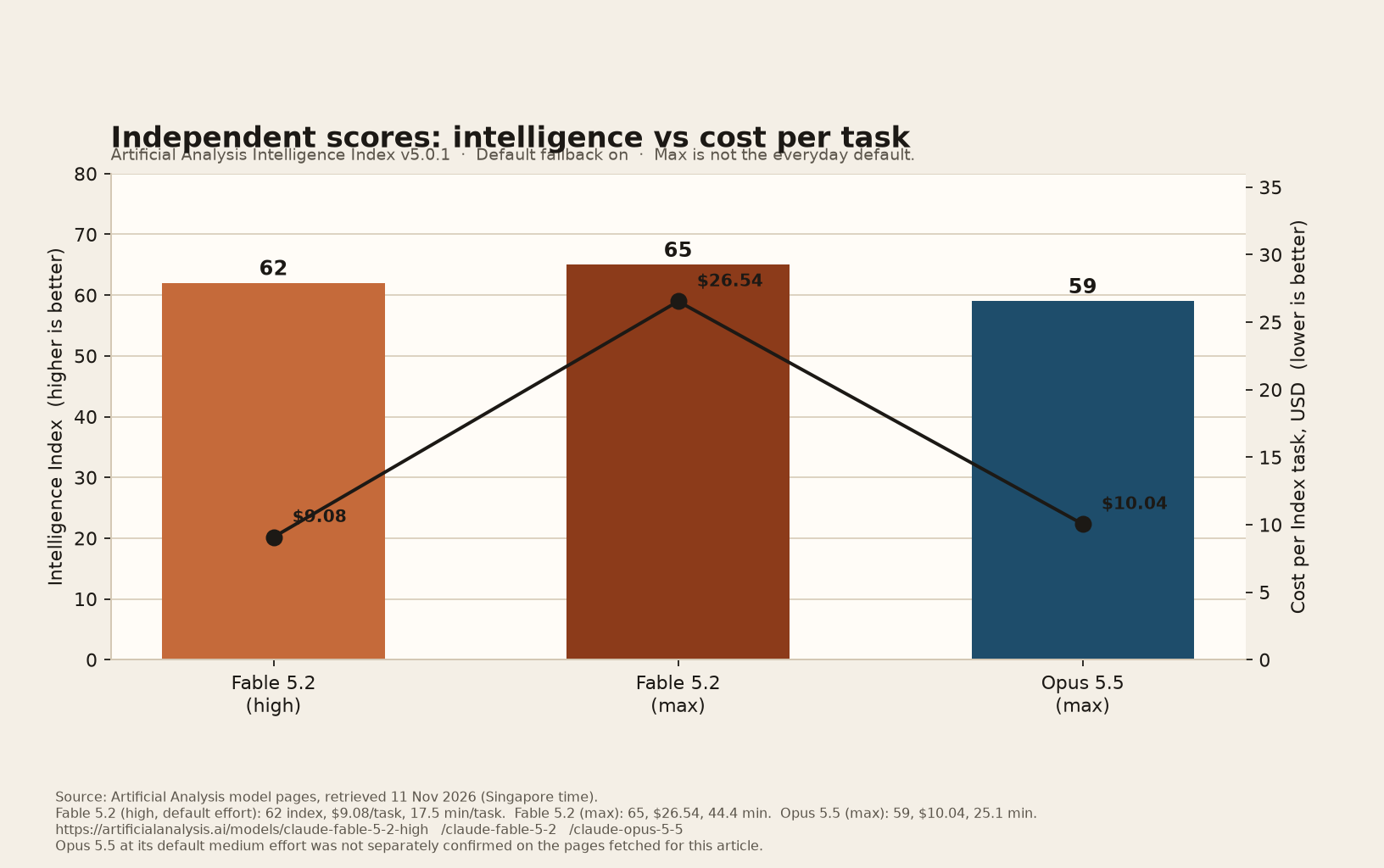
The independent source I could verify in full is Artificial Analysis’s Intelligence Index v5.0.1. The index blends nine evaluations, including AA-Briefcase, AutomationBench-AA, Terminal-Bench 4.0, FrontierCode 2.0, AA-Omniscience, GDP.pdf, HLE-Diamond, CritPt v2 (hard subset), and Terminal-Bench-Science. The figures below come from the model-page summaries and FAQs retrieved on 11 November 2026, with Anthropic’s default fallback enabled.
 🔍 View full resolution
| Setup | Index (higher is better) | Cost per task | Time per task | Time to first answer token | Output speed |
|---|---|---|---|---|---|
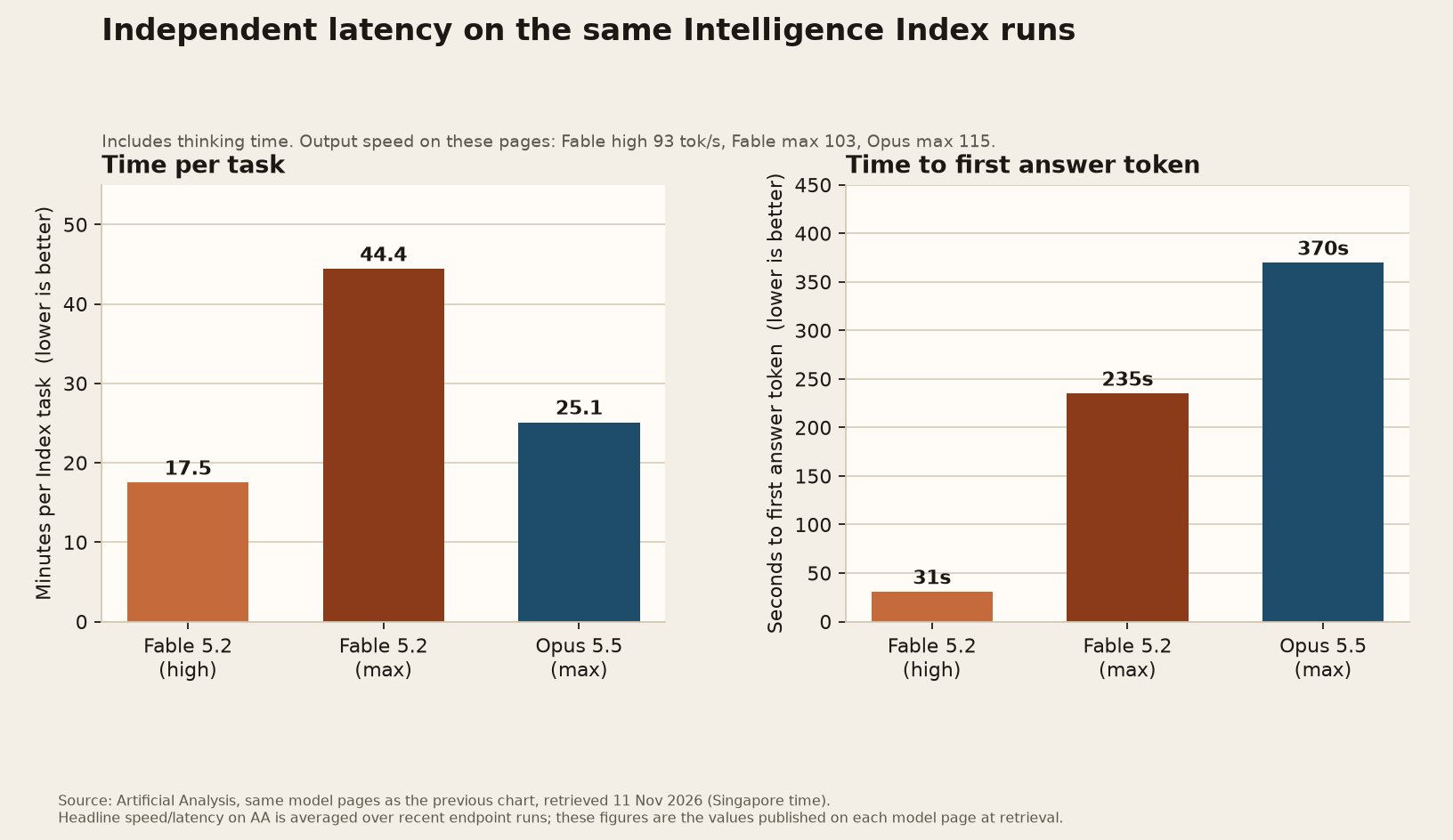
Fable 5.2, high (API default) | 62 | $9.08 | 17.5 min | 30.79s | 93 tok/s |
Fable 5.2, max | 65 | $26.54 | 44.4 min | 235.06s | 103 tok/s |
Opus 5.5, max | 59 | $10.04 | 25.1 min | 369.72s | 115 tok/s |
 🔍 View full resolution
Three caveats matter more than the ranking.
First, max is not Fable’s default. At high, Fable scores 62 and costs $9.08 per Index task, against 59 and $10.04 for Opus at max. It also finishes the Index tasks faster. Pushing Fable to max adds three Index points and jumps the cost from $9.08 to $26.54, while time per task rises from 17.5 minutes to 44.4.
Second, these costs and times are for Artificial Analysis’s mix of tasks, not for your backlog. Opus at max even has a slightly higher output speed (115 tok/s vs 103). Thinking time and total tokens still decide when a job actually ends.
Third, the detailed bar charts on those pages did not come through as readable tables in the text extract. Sub-scores are cited only where Artificial Analysis also stated them in its official post on 9 November: Fable’s max run led on science, knowledge, and FrontierCode 2.0; AA-Briefcase Elo was 1785 for Fable and 1800 for Opus, within the confidence interval; both models scored 60% on Terminal-Bench 4.0; GDP.pdf all-pass was 24% for Fable and 26% for Opus. In other words, the independent data also says Fable’s lead is strongest on harder science and some coding work, not a uniform gap on everyday knowledge work or terminal coding.
I did not find a separate Artificial Analysis page for Opus 5.5 at its default medium effort, so that number is omitted rather than guessed. I also did not find an LMSYS Arena result for Fable 5.2 in this pass.
Developer and Community Early Feedback
Most posts on X were recaps of the announcement or of the Intelligence Index. Those are not hands-on tests. A few items were specific enough to quote, with the usual limits.
GitHub’s official account said Fable 5.2 is generally available in GitHub Copilot. In GitHub’s early testing, Fable 5.2 solved more tasks than Fable 5.1, used fewer steps and tool calls, and completed difficult tasks that earlier models missed. That comparison is with 5.1, not with Opus 5.5.
One subscriber, Ashray Malhotra, wrote that Opus 5.5 is efficient enough that the $100 Max plan already covers their work, and that they are waiting to see whether Fable 5.2 is the reason to pay for Ultra. They also asked Anthropic to lift the 50% weekly cap on Fable. That is one person’s bill, not a usage study.
An account named kilnframe published an in-house benchmark: the same 11-second clip, the same code, all three models run the same day. Fable 5.2 took 11.1 minutes and $6.27; Fable 5.1 took 5.9 minutes and $2.92; Opus 5.5 took 7.6 minutes and $2.19. On that task, the new Fable was slower and more expensive. A different task could go the other way, so this is not treated as a general result.
Discovered Materials said Fable 5.2 sped up DFT and DFPT paths in Quantum ESPRESSO by about 36× and 9×. Similar wording appears in Anthropic’s announcement, so it is recorded as an early-tester claim, not as an outside replication.
In community field tests, developer Matthew Berman evaluated complex web applications including game prototypes and spreadsheet tools using Fable 5.2 in his review video (video link). While highlighting Fable's capability on large, multi-turn coding projects, Berman emphasized that Opus 5.5 remains substantially faster and more economical for day-to-day software development.
A YouTube search on the same day also surfaced older Fable 5 and Fable 5.1 reviews. Those are different models and were not used here.
Architecture Decision Flow and Cost Optimization
 🔍 View full resolution
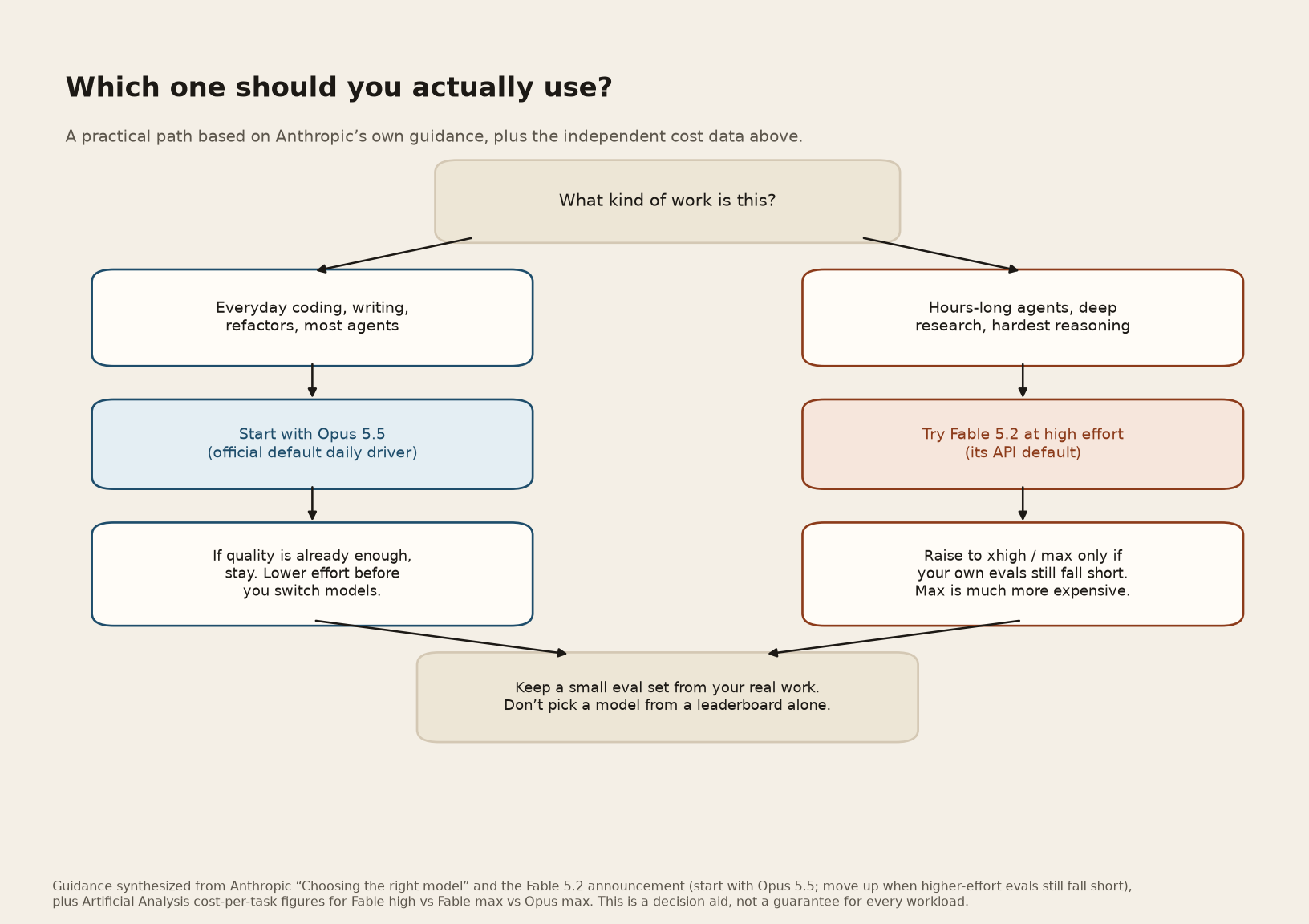
Work through it in this order, instead of starting with whoever sits at the top of a chart.
- Know which meter you are on. If you work in the Claude apps or Claude Code, check whether Fable is included in your plan and what happens when you exceed the cap. If you call the API, you are on token prices. Pro users in particular should remember that Opus is in the plan and Fable, under standing terms, is paid with credits.
- Start daily work on Opus 5.5. That matches the official docs. Tune effort before you change models.
- Bring in Fable for the hard, long jobs, and start at
high. In the independent data, that setting already looks better value than Opus atmax. Move toxhighormaxonly if your own evals still fail. - Keep a small set of your real tasks. Two days after launch, the public independent picture is one composite index and one official analyst thread. There is not yet a thick set of third-party reports on ordinary site work, admin tools, or content pipelines.
A pattern that already exists in Anthropic’s docs is to let a cheaper model do the volume and to call Fable as an advisor, or to have Fable orchestrate and hand simpler steps down. That is often a better default than running Fable on every turn.
Evaluation Notes and Practical Boundaries
When selecting models for production-grade agent workflows and automated coding pipelines, engineering teams should apply the following guidelines:
- Active Spend Monitoring: Subscription allowances and API rate limits evolve with cloud vendor updates; configure usage alerts in workspace consoles before deploying high-concurrency jobs.
- Separate Daily Work from Heavy Reasoning: Opus 5.5 offers a superior speed-to-cost ratio for 80% of routine coding and refactoring tasks; reserve Fable 5.2 for architectural spikes, multi-hour autonomous runs, or edge-case bug fixes.
- Validate on Internal Baselines: Leaderboard metrics rely on synthetic prompts that rarely match production repositories; teams should establish a project-specific evaluation suite of unit tests and regression tasks.
- Calibrate Reasoning Effort Carefully: Fable 5.2's default high effort delivers the strongest value per dollar; jumping directly to max multiplies token consumption and latency with diminishing marginal gains.
Systematic internal benchmarking and deliberate tier routing remain the most reliable path to balancing engineering velocity with API operational costs.