What the limits page hard-codes
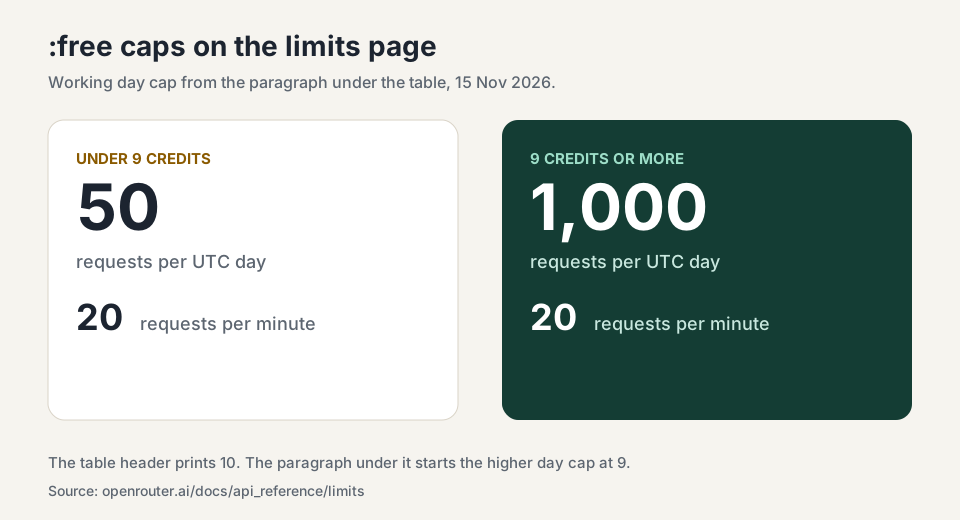
On 15 November 2026 the limits page prints two rows. Under 10 credits: 20 requests per minute and 50 per UTC day. At 10 credits: 20 per minute and 1,000 per UTC day. The paragraph under that table moves the day-cap switch to 9 credits, one below the printed 10, to absorb rounding and top-up fees. That paragraph is the working rule: below 9 credits the day cap is 50, and from 9 credits it is 1,000. The minute cell stays 20 on both rows.
 🔍 View full resolution
An account below 9 credits can report is_free_tier false and still sit on 50 a day. The daily count is free_model_daily_requests on GET /api/v1/key, for the current UTC day. The per-minute limit is absent from that payload.
 🔍 View full resolution
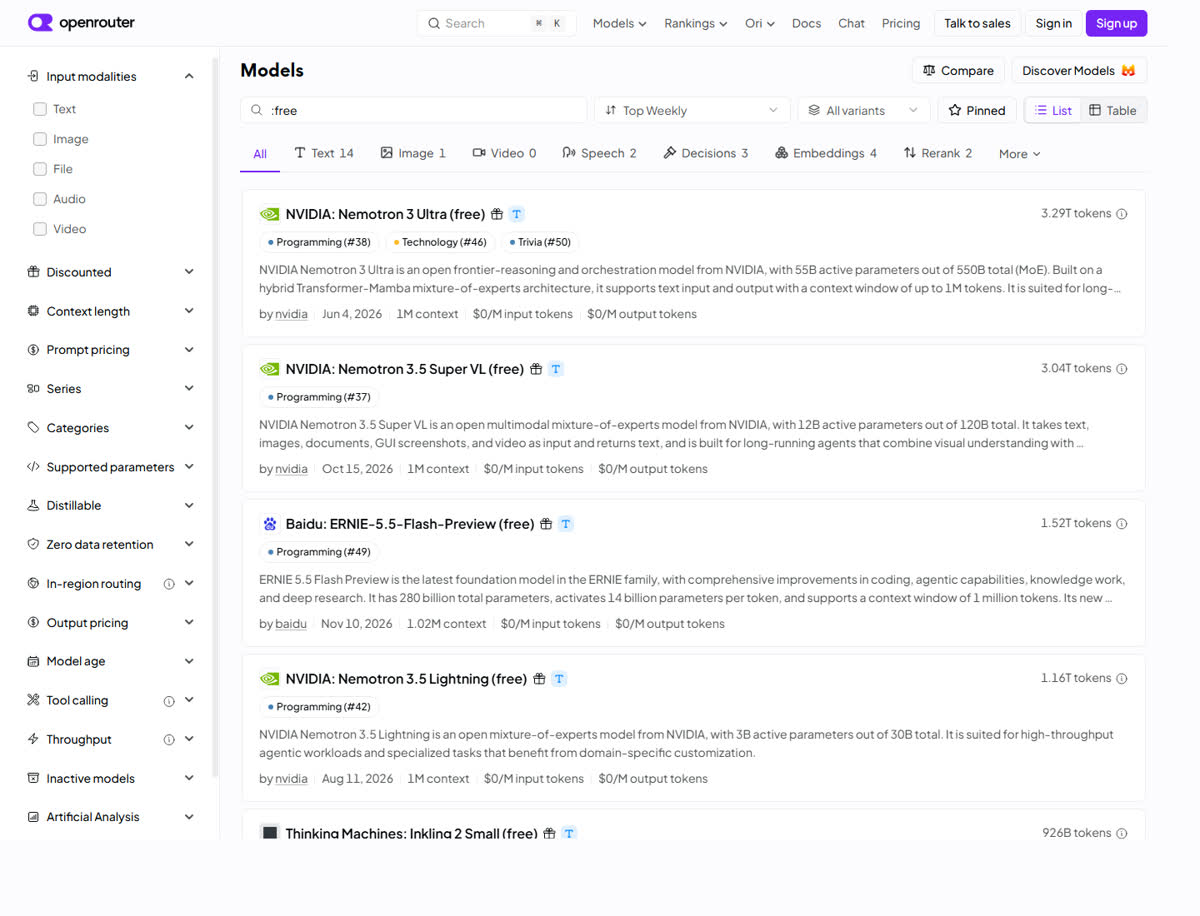
Token price sits on a different page. The public models list the same day returned 14 IDs ending in :free. Each one had a prompt price of 0 and a completion price of 0. The cards in the screenshot, including Nemotron 3.5 Super VL, print the same $0/M input and $0/M output.
Sign-up: openrouter.ai
Quota page: openrouter.ai/docs/api_reference/limits
How to split the 50 calls
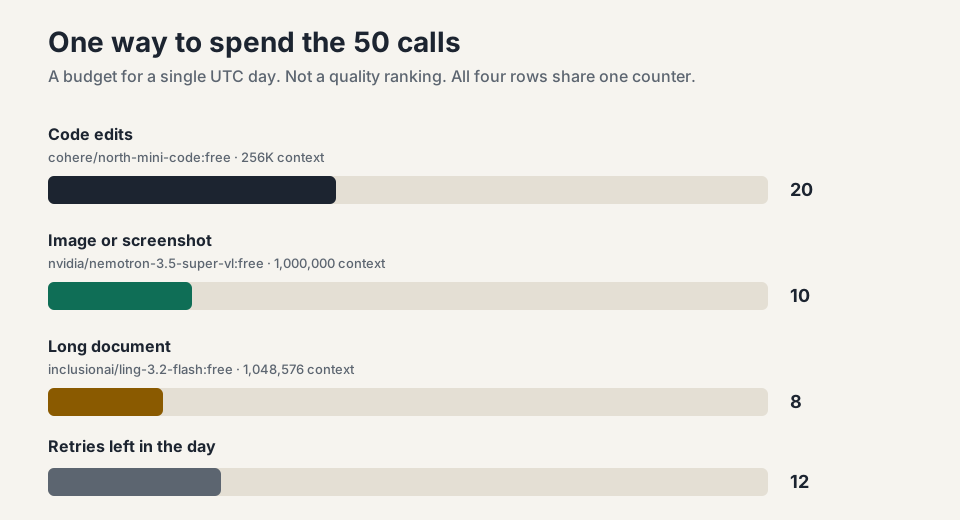
Every ID ending in :free draws on this daily ceiling, and a second API key does not add another 50. The limits page opens by saying extra accounts and extra API keys do not change these rate limits. The split below follows the context window and the input types on each card. No timed test sits behind the call counts. 20 + 10 + 8 + 12 = 50.
 🔍 View full resolution
| Job | Model ID on 15 Nov 2026 | Context | Detail taken from the card | Calls |
|---|---|---|---|---|
| Code edits | cohere/north-mini-code:free | 256,000 | Mixture-of-experts, 30B total, 3B active. Prompt and completion priced at 0. | 20 |
| Image or screenshot | nvidia/nemotron-3.5-super-vl:free | 1,000,000 | 12B active of 120B. Card lists images, documents, and screenshots. Price 0. | 10 |
| Long document | inclusionai/ling-3.2-flash:free | 1,048,576 | Text and image input. Card says up to 200 images per request. Price 0. | 8 |
| Retries | Any other :free ID still priced at 0 | Varies | Held so one rejected call does not end the day. | 12 |
Try it: openrouter.ai/cohere/north-mini-code:free
Try it: openrouter.ai/models?q=:free
The minute cap runs out first
A tight loop meets the minute line first. The constant on the page is 20 per minute, and the day cap below 9 credits is 50.
The rate-limit tutorial dated 11 November 2026 records minutes with more than 20 successes and says to treat 20 as the point where a 429 can start, not as an exact count of accepted calls. The same tutorial says one per-minute limiter covers all free models on an account, so switching from one :free ID to another does not open a fresh minute. Two example IDs in that tutorial, poolside/laguna-s-2.1:free and minimax/minimax-m3.1-flash:free, were not among the 14 :free rows returned on 15 November 2026.
A negative credit balance can fail the call even when the ID ends in :free. The limits page says adding credits until the balance is above zero turns those models back on. Creating another account or another API key does not change these rate limits. That line opens the same limits page, so a new signup is not a second bundle of 50 calls.
Limits page: openrouter.ai/docs/api_reference/limits
The models-list blurb for liquid/lfm-3-1.7b:free, a 1.7B model with a 256,000 context also priced at 0, stops at this fragment: "Prompts and outputs may be retained and used". The public blurb ends in an ellipsis, so the sentence is not completed here.
Which lane fits the day
Choose the 50-call split if: the day is about 20 code edits on North Mini Code, 10 image or screenshot prompts on Nemotron 3.5 Super VL, and 8 long-document passes on Ling 3.2 Flash, with 12 calls held for a retry. Prompt and completion on those cards were $0 on 15 Nov 2026.
Choose 9 credits if: the day needs more than 50 calls and 20 per minute is still enough. From 9 credits the day cap in the paragraph under the table is 1,000. The minute cap stays 20. The table header prints this row as 10.
Choose a model ID without the :free suffix if: the loop cannot wait on 20 requests a minute. The limits page says that paid variant has no platform-level request cap and is billed per token. Paid token rates are not copied here. The rows above are the ones priced at $0.
Choose Groq's free tab if: one vendor and a larger daily request count matter more than switching IDs. The Groq free-tab note from the same day lists 1,000 requests a day and 200,000 tokens a day. Write-up: Groq Free API 2026.