What the pricing page prints
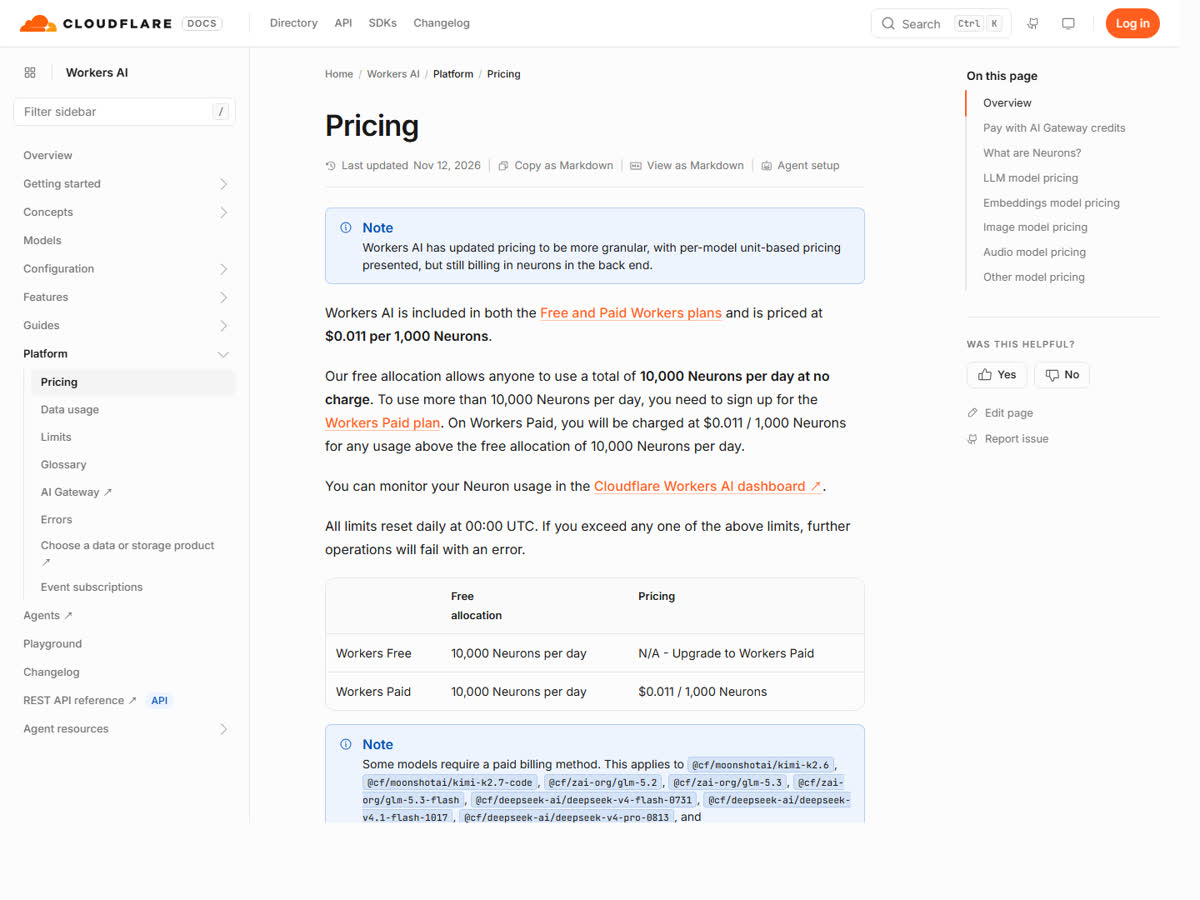
On 15 November 2026 the Workers AI pricing page, marked last updated 12 November 2026, states one unit price: $0.011 per 1,000 neurons. The free allocation on that page is 10,000 neurons per day for both Workers Free and Workers Paid. Workers Free cannot continue past the allocation. Workers Paid pays the $0.011 rate on usage above it. The page says every limit resets at 00:00 UTC, and that crossing a limit makes later operations fail.
 🔍 View full resolution
Neurons are Cloudflare's name for the GPU work behind a request. The same page prints a token price next to a neuron price and says the two columns match. The figures below use the neuron column.
API setup: developers.cloudflare.com/workers-ai/get-started/rest-api
Pricing: developers.cloudflare.com/workers-ai/platform/pricing
How many calls 10,000 neurons buy
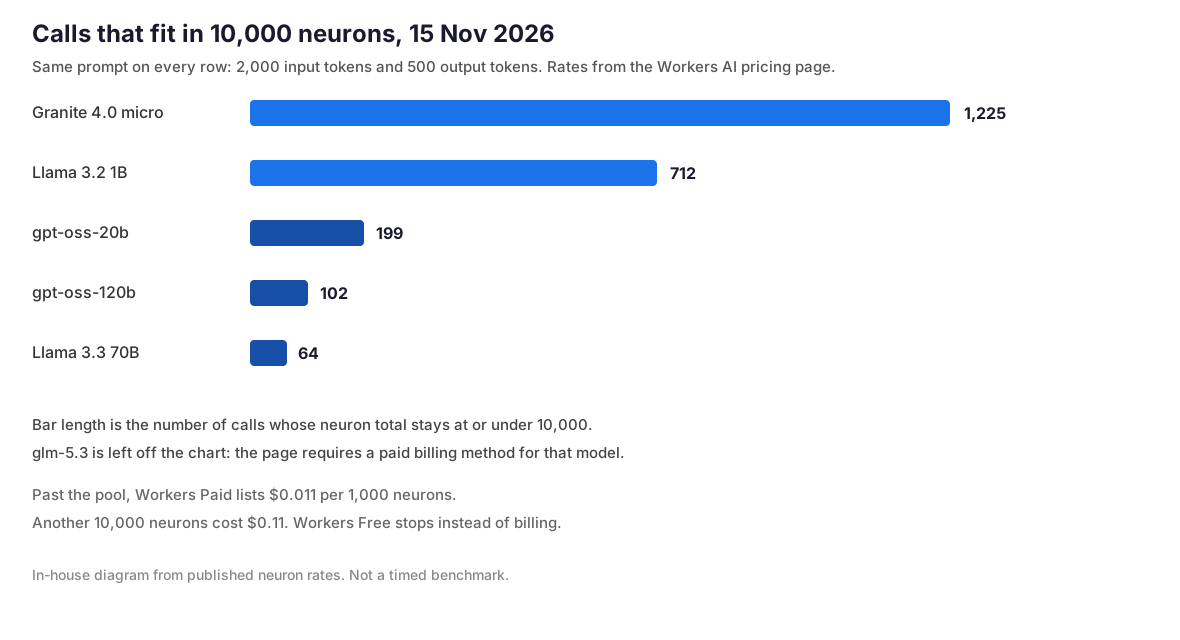
The arithmetic uses one prompt shape on every row: 2,000 input tokens and 500 output tokens. Neuron cost is (input tokens / 1,000,000) times the input rate, plus (output tokens / 1,000,000) times the output rate. A call counts only when the running total stays at or under 10,000. This is page arithmetic, not a timed run.
 🔍 View full resolution
| Model on the page | Neurons / 1M in | Neurons / 1M out | This prompt | Calls under 10,000 |
|---|---|---|---|---|
| granite-4.0-h-micro | 1,542 | 10,158 | 8.163 | 1,225 |
| llama-3.2-1b-instruct | 2,457 | 18,252 | 14.040 | 712 |
| gpt-oss-20b | 18,182 | 27,273 | 50.0005 | 199 |
| gpt-oss-120b | 31,818 | 68,182 | 97.727 | 102 |
| llama-3.3-70b-instruct-fp8-fast | 26,668 | 204,805 | 155.7385 | 64 |
gpt-oss-20b is the row that looks round and is not. Two hundred calls cost 10,000.1 neurons, a tenth over the pool, so the last call that still fits is number 199. Granite's 1,225th call lands at 9,999.675. The 1,226th crosses.
Whisper on the same page is 41.14 neurons per audio minute. 243 minutes land at 9,997.02 neurons. A 244th minute crosses. That line is for audio, not for the chat table above.
The same gpt-oss-120b is metered differently on Groq's free tab, checked the same day: 30 requests per minute and 200,000 tokens a day. The write-up is Groq Free API 2026.
Nine models skip the free pool
A note under the allocation table says some models require a paid billing method. The IDs on the page are kimi-k2.6, kimi-k2.7-code, glm-5.2, glm-5.3, glm-5.3-flash, deepseek-v4-flash-0731, deepseek-v4.1-flash-1017, deepseek-v4-pro-0813, and inkling-2-small, each under its @cf/... prefix. The page says those models can be called with the Workers Paid plan or with prepaid AI Gateway credits.
glm-5.3's published rate is 127,273 neurons per million input tokens and 400,000 per million output tokens. The sample prompt would cost 454.546 neurons, and 21 such calls would still sit under 10,000. That arithmetic does not put the model on Workers Free. The paid-billing note overrides the pool.
On Workers Paid, neurons past 10,000 bill at $0.011 per 1,000. Another full pool of 10,000 neurons is $0.11. One of those $0.011 slices is 1,000 neurons, which covers 122 Granite calls of this prompt size (122 x 8.163 = 995.886) and does not cover a 123rd. The monthly price of the Workers Paid plan is not printed on this pricing page, so it is not added here.
Which model to point at the pool
Choose Granite 4.0 micro if: the job is a short classification or a small rewrite, and the day has to cover more than a thousand calls. At this prompt size the pool holds 1,225.
Choose gpt-oss-20b if: a larger open model is the point and about 200 calls a day are enough. Budget 199, not 200.
Choose gpt-oss-120b or Llama 3.3 70B if: the day is a few dozen longer replies. The pool holds 102 calls at 97.727 neurons, or 64 calls at 155.7385. A 70B reply spends the day about 19 times faster than Granite on this prompt (155.7385 / 8.163 = 19.08).
Move to Workers Paid or AI Gateway credits if: the call needs one of the nine IDs in the paid-billing note, or the job needs more than 10,000 neurons. The overflow rate on the page is $0.011 per 1,000 neurons. Workers Free does not bill the overflow. It stops.